Wright Brothers: The Two Brothers Who Were Told Humans Would Never Fly
The incredible story of Orville and Wilbur Wright — two bicycle mechanics with no college education, no money, and no government support, who solved the mystery of human flight and changed the world forever.
Chronica Editorial · · 11 min read
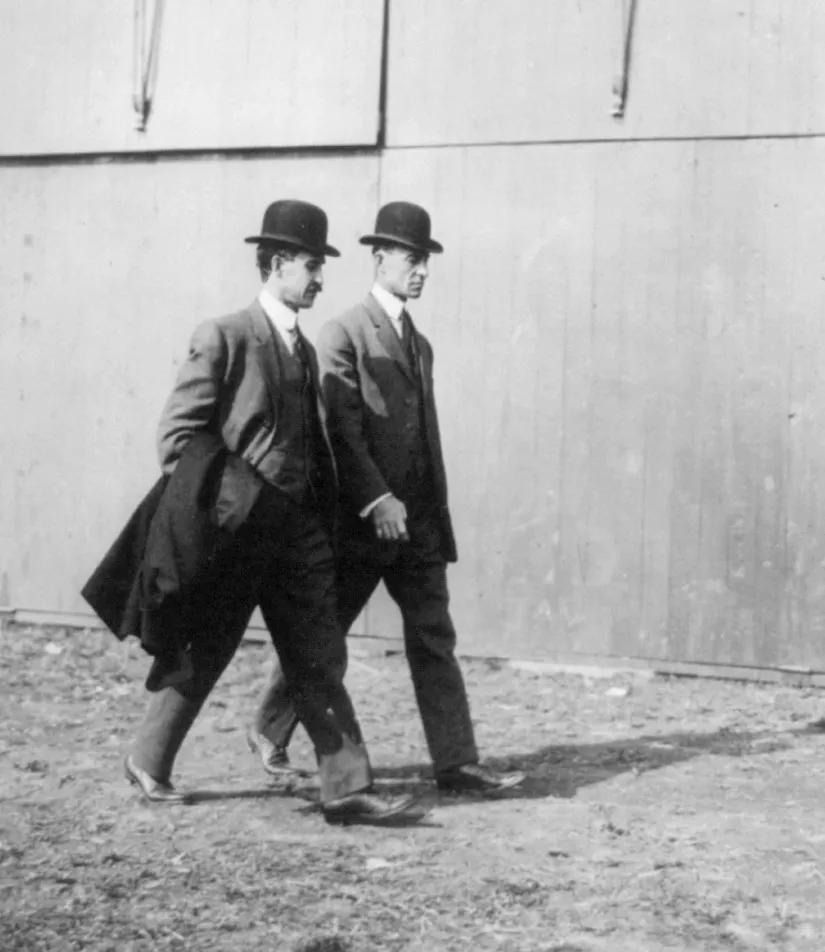
On December 17, 1903, on a cold, windy beach in Kitty Hawk, North Carolina, a strange-looking machine lifted off the ground and flew for 12 seconds. The distance covered was 120 feet — less than the length of a modern Boeing 747.
There were only five witnesses. Most newspapers didn't bother to report it. The world didn't believe it. But on that day, humanity left the ground forever.
The men who did it were not scientists. They were not professors. They were two brothers who ran a bicycle shop in Dayton, Ohio. They had no college education, no government funding, and no wealthy backers. They had only each other, a dream, and a stubborn refusal to accept that humans could not fly.
This is the story of Orville and Wilbur Wright.
The Flying Toy That Started Everything Wilbur Wright was born in 1867, and his brother Orville was born in 1871. They were the sons of Milton Wright, a bishop, and Susan Koerner Wright, a mechanical genius who designed and built her own household appliances. The boys inherited their mother's mechanical talent.
One winter day in 1878, their father brought home a toy — a small helicopter made of cork, bamboo, and rubber bands, based on a design by the French aeronautical pioneer Alphonse Pénaud. The boys were fascinated. They played with it until it broke, then built their own. It was their first taste of flight.
The family moved frequently because of their father's church assignments. The boys attended high school but never graduated. Wilbur was supposed to go to Yale, but a hockey accident — a stick to the face — left him housebound for years, caring for his dying mother. He became a recluse, reading books from his father's library, developing a quiet, thoughtful mind.
Orville was the more energetic and mischievous brother. He dropped out of high school to start a printing business, and Wilbur joined him. They published a weekly newspaper called the West Side News, then a daily paper called the Evening Item. It was their first business together.
Then they discovered bicycles.
The Bicycle Shop That Built an Airplane In 1892, the brothers opened a bicycle repair shop and soon began manufacturing their own bicycles. The bicycle craze was sweeping America, and the Wright brothers were at the center of it. Their shop, the Wright Cycle Company, became a local institution.
Bicycles taught them something crucial: balance. A bicycle is inherently unstable — it falls when it stops. But a moving bicycle can be balanced by a rider who understands how to shift weight and steer. The brothers realized that an aircraft would face the same problem: how do you control a machine that is inherently unstable?
They read everything they could find about flight. They studied the work of Otto Lilienthal, the German glider pioneer who had made over 2,000 glides before dying in a crash in 1896. They studied Samuel Langley, the Smithsonian scientist who was building a steam-powered flying machine with government funding. They studied Octave Chanute, an American engineer who had written a book on flying machines.
They wrote to the Smithsonian Institution and asked for everything they had on aeronautics. The Smithsonian sent them a list of books and papers. The brothers read them all.
They discovered something shocking: the existing data on aerodynamics was wrong. Lilienthal's tables of lift and drag were based on flawed experiments. The brothers realized they would have to do their own research.
Kitty Hawk: The Wind, the Sand, and the Gliders The Wright brothers needed a place to test their gliders. They wrote to the U.S. Weather Bureau and asked for a location with steady winds and soft ground for landing. The answer came back: Kitty Hawk, North Carolina — a remote sandbar on the Outer Banks, with winds averaging 15-20 miles per hour.
In 1900, they made their first trip to Kitty Hawk. They camped in a tent, battled mosquitoes, and flew their first glider — a small biplane with a 17-foot wingspan. It flew, but not well. They returned home and built a bigger one.
In 1901, they returned with a larger glider. It flew, but the brothers were disappointed. It didn't generate enough lift. They realized the data they were using was wrong.
They went back to Dayton and built a wind tunnel — a wooden box with a fan and a balance scale — and tested over 200 different wing shapes. They tested wing curves, aspect ratios, and angles. They discovered that a long, narrow wing was far more efficient than a short, wide one. They also discovered that the "Smeaton coefficient" — a number used in all lift calculations — was wrong.
Their wind tunnel experiments were revolutionary. They had invented a new science: experimental aerodynamics. They had no formal training, but they had something better: a systematic, scientific approach.
The Breakthrough: Three-Axis Control The Wright brothers' greatest contribution to aviation was not the airplane itself. It was the system of control.
Other inventors had built gliders and even powered machines. But none of them could control their aircraft. They could fly in a straight line, but they couldn't turn, climb, or descend safely. The machine would flip, spin, and crash.
The Wright brothers realized that a flying machine needed three types of control:
Pitch — moving the nose up or down
Yaw — moving the nose left or right
Roll — rotating the wings around the fuselage
They invented a system that controlled all three simultaneously. Their key innovation was "wing warping" — twisting the wings to make one side generate more lift than the other. This allowed the aircraft to roll and turn.
They combined this with a movable rudder at the back and an elevator at the front. The pilot controlled all three with a single mechanism. It was the first practical flight control system in history.
In 1902, they returned to Kitty Hawk with a new glider incorporating all their discoveries. They made over 1,000 glides, some lasting over 26 seconds and covering over 600 feet. The glider worked. They had solved the problem of control.
Now they needed an engine.
The Engine That Nobody Would Build The Wright brothers wrote to several automobile companies, asking them to build a lightweight gasoline engine. No company would do it. The engines were too heavy, too unreliable, or too expensive.
So they built their own.
With the help of their mechanic, Charlie Taylor, they designed and built a 12-horsepower engine in just six weeks. It weighed 152 pounds — lighter than any comparable engine. Taylor machined the parts himself, using a drill press and a lathe in the bicycle shop.
They also designed and carved their own propellers, using wind tunnel data. They discovered that a propeller was essentially a rotating wing, and they designed it accordingly. Their propellers were 66% efficient — far better than anything else at the time.
The machine was called the Wright Flyer. It had a wingspan of 40 feet, weighed 605 pounds, and cost less than $1,000 to build.
December 17, 1903: The First Flight They returned to Kitty Hawk in the fall of 1903. The weather was terrible — cold, windy, and rainy. They assembled the Flyer, made repairs, and waited for the right conditions.
On December 14, Wilbur won the coin toss and made the first attempt. The Flyer rose a few feet, stalled, and crashed into the sand. It was damaged but repairable. It would take three days to fix.
On December 17, the wind was strong — 27 miles per hour. They knew it was risky, but they had run out of time. They would have to leave soon. They decided to try.
Orville won the coin toss this time. At 10:35 AM, he lay down on the lower wing, started the engine, and released the restraining wire. The Flyer moved forward along a wooden rail. Wilbur ran alongside, steadying the wing.
The Flyer lifted off. It flew 120 feet in 12 seconds. It was the first controlled, powered, sustained flight of a heavier-than-air machine in history.
They made three more flights that day. The last one, piloted by Wilbur, covered 852 feet and lasted 59 seconds. Then a gust of wind flipped the Flyer, damaging it beyond repair.
They walked four miles to the weather station and sent a telegram to their father:
"Success. Four flights Thursday morning. All against twenty-one-mile wind. Started from level with engine power alone. Average speed through air thirty-one miles. Longest 57 seconds. Inform press. Home Christmas."
The press was not interested. Only a few newspapers reported the story, and most got the details wrong. The world did not believe that two bicycle mechanics from Ohio had flown.
The World's Doubt — And the Wrights' Determination The Wright brothers returned to Dayton and continued their work. They built a new Flyer and invited reporters to watch them fly. But the reporters were skeptical, and the flights were disappointing. The brothers' secretive nature — they refused to share their designs — made the press suspicious.
Meanwhile, other inventors claimed to have flown first. Samuel Langley had attempted a flight in October 1903, just two months before the Wrights, but his machine had crashed into the Potomac River. The Smithsonian Institution supported Langley's claims, and the Wrights were dismissed as frauds.
In 1905, they built the Wright Flyer III — the first practical airplane. It could fly for over 30 minutes, cover 24 miles, and perform turns and circles. They knew they had solved the problem. But they still couldn't convince the world.
They tried to sell their invention to the U.S. government. They were rejected. They tried to sell it to European governments. They were rejected. Nobody believed that two unknown bicycle mechanics had invented the airplane.
Then came the turning point. In 1908, the brothers split up. Wilbur went to France, and Orville stayed in America to demonstrate the Flyer to the U.S. Army.
On August 8, 1908, Wilbur made his first public flight in France. The crowd watched in stunned silence as the Flyer circled the field, banking and turning with perfect control. The French, who had believed their own inventors were leading the race, were astonished.
The Paris newspapers wrote:
"We are beaten. We have been beaten. The French have been beaten by the Americans."
The world finally believed.
The Legacy The Wright brothers became international celebrities. They were awarded medals, honors, and patents. They founded the Wright Company in 1909 and built airplanes for the U.S. Army. They won a famous patent battle against Glenn Curtiss, establishing the basic principle of flight control.
Wilbur died of typhoid fever in 1912, at the age of 45. Orville lived until 1948, witnessing the transformation of the airplane from a fragile experiment into a machine that could cross oceans and win wars. He saw the first jet planes and the first helicopters. He saw the world shrink.
The Wright brothers never married. They lived together their entire lives, and their bond was the foundation of their success. They argued, debated, and challenged each other constantly. They were not just brothers — they were partners.
The Wright Flyer is now in the Smithsonian Institution in Washington, D.C. It is the most famous airplane in history.
Lessons from the Wright Brothers' Lives No education is a barrier to genius — They had no college degrees, but they invented experimental aerodynamics.
Study everything — They read every book, wrote to the Smithsonian, and learned from everyone.
Do your own research — When the data was wrong, they built a wind tunnel and tested it themselves.
Build your own tools — When no company would build their engine, they built it themselves.
Control is everything — They didn't just build a plane. They solved the problem of flying it.
Persistence beats rejection — The world ignored them for years. They kept going.
Teamwork wins — The Wright brothers succeeded because they worked together as equals.
Conclusion The Wright brothers did not just invent the airplane. They invented the science of flight. They were not dreamers — they were engineers. They took a wild idea and made it real through hard work, careful research, and relentless experimentation.
They were told humans would never fly. They flew anyway. They were ignored, dismissed, and mocked. They kept flying.
They said it themselves:
"The desire to fly is an idea handed down to us by our ancestors who, in their grueling travels across trackless lands in prehistoric times, looked enviously on the birds soaring freely through space, at full speed, above all obstacles, on the infinite highway of the air."
And:
"If we all worked on the assumption that what is accepted as true is really true, there would be little hope of advance."
The Wright brothers flew because they questioned what was accepted as true. They changed the world because they refused to accept limits.