Thomas Edison: The Man Who Failed 1,000 Times and Lit Up the World
The incredible story of Thomas Edison — the boy whose teacher called him "too stupid to learn," who went on to hold 1,093 patents and invented the light bulb, phonograph, and the modern world of invention itself.
Chronica Editorial · · 5 min read
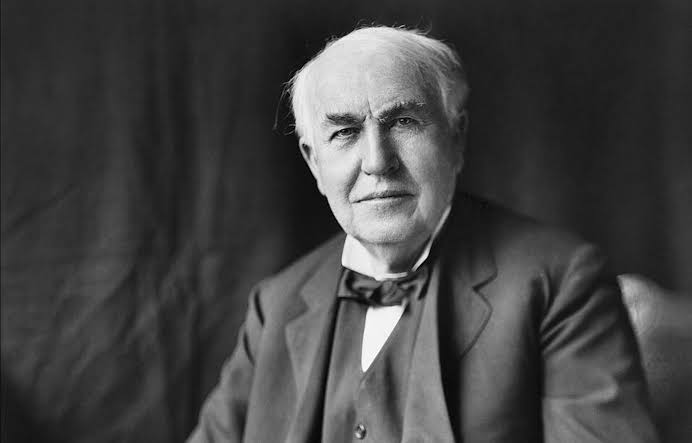
Imagine a world where the sun sets and everything goes dark. No streetlights, no lamps, no glowing screens. That was the world before Thomas Alva Edison — the man who didn't just invent the light bulb, but invented the very idea of the modern "invention factory."
The Boy They Called "Slow"
Thomas Edison was born on February 11, 1847, in Milan, Ohio, USA. He was a curious, hyperactive child who asked endless questions. His school teacher lost patience with him and declared him "addled" — too stupid to learn. Young Thomas lasted only 12 weeks in school.
His mother, Nancy Edison, refused to accept this. She pulled him out of school and taught him at home. Later, Edison would famously say:
> _"My mother was the making of me. She was so true, so sure of me; and I felt I had something to live for, someone I must not disappoint."_
At home, his curiosity exploded. By age 12, he was selling newspapers and candy on the Grand Trunk Railroad. But he wasn't just selling papers — he had set up a small chemistry laboratory in a train baggage car, conducting experiments between stops. One accidental fire ended that lab, but not his passion.
The Hearing That Changed Everything
Edison lost most of his hearing at a young age due to scarlet fever and untreated ear infections. Instead of breaking him, this deafness became his secret weapon. He once said it helped him block out noise and concentrate deeply on his work. Where others saw disability, Edison saw focus.
The Telegrapher Who Became an Inventor
At 15, Edison saved a young boy from being hit by a runaway train. The grateful stationmaster taught him telegraphy as a reward. Edison became a telegraph operator — and quickly became obsessed with improving the machines around him.
His first invention, an automatic vote recorder for politicians, was a flop — politicians didn't want it. Edison learned a life-changing lesson:
> _"Anything that won't sell, I don't want to invent. Its sale is proof of utility, and utility is success."_
From that day on, he invented things people actually needed.
Menlo Park: The Invention Factory
In 1876, Edison did something revolutionary — he opened the world's first industrial research laboratory at Menlo Park, New Jersey. He called it his "invention factory," and his goal was simple: a minor invention every 10 days, a big one every six months.
The inventions came fast:
- The Phonograph (1877) — the first machine that could record and play back sound. When it worked, Edison himself was stunned. The world called him "The Wizard of Menlo Park." - The Practical Light Bulb (1879) — not the first light bulb ever made, but the first one that was safe, affordable, and long-lasting enough to light homes and cities. - The Motion Picture Camera (1891) — opening the door to Hollywood. - The Carbon Microphone — which made telephone conversations possible.
The 1,000 Failed Experiments
The light bulb didn't come easy. Edison and his team tested thousands of materials for the filament — bamboo, platinum, even human hair. When a journalist asked him how it felt to fail so many times, Edison gave one of history's greatest replies:
> _"I have not failed. I've just found 10,000 ways that won't work."_
And:
> _"Genius is one percent inspiration, ninety-nine percent perspiration."_
When the bulb finally glowed, Edison didn't stop at the bulb. He built the entire electrical system — generators, wiring, meters, and the first power station in New York City in 1882. The world's first electrically lit district glowed on Pearl Street — and the dark ages of night were over.
The War of the Currents
Edison's biggest battle wasn't technical — it was personal. He engaged in the famous "War of the Currents" against George Westinghouse and Nikola Tesla, promoting his Direct Current (DC) over their Alternating Current (AC). Edison eventually lost that war — AC became the standard — proving that even the greatest inventor isn't always right.
Yet Edison never let rivalry slow him down. He went on to found General Electric (GE), one of the largest companies in the world to this day.
By the Numbers
- 1,093 U.S. patents — still one of the highest in history - 1,000+ failed attempts before the light bulb succeeded - Founded 14 companies, including General Electric - Invented or improved: light bulb, phonograph, movie camera, batteries, telegraph systems, and more
Lessons from Thomas Edison's Life
1. Failure is data — Every "failed" experiment showed him what didn't work. 2. Labels don't define you — The boy called "stupid" out-invented the entire world. 3. One person's belief can change everything — His mother's faith in him built his confidence. 4. Hard work beats talent — "One percent inspiration, ninety-nine percent perspiration." 5. Sell what people need — Genius without usefulness is just a hobby. 6. Never stop after one win — He kept inventing for 60 more years after the light bulb.
Conclusion
Thomas Edison died on October 18, 1931. On the night of his funeral, as a tribute, millions of homes and streetlights across America were dimmed for one minute — the world briefly returned to darkness to honor the man who took it away forever.
Every time you flip a switch, remember: it exists because one man refused to give up after 10,000 failures.
_What would you have done after failing 1,000 times? Tell us in the comments below!_