Nikola Tesla: The Man Who Electrified the World — And Died Alone in a Hotel Room
The tragic story of Nikola Tesla — the genius who invented alternating current, dreamed of wireless power, and gave the world the electricity system it still uses today, yet died poor and forgotten in a New York hotel room.
Chronica Editorial · · 10 min read
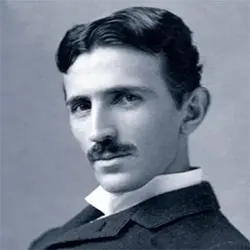
Every time you plug in a device, turn on a light, or charge your phone, you are using the system Nikola Tesla imagined in his mind before anyone else. He gave the world alternating current — the electricity that powers cities. He invented the induction motor, the Tesla coil, wireless transmission, radio, remote control, and neon lighting. Over 300 patents carried his name. And yet, he died alone in a New York hotel room, in debt, forgotten by the world he had electrified.
This is the story of the greatest forgotten genius in history.
The Boy Who Saw the Future Nikola Tesla was born on July 10, 1856, in Smiljan, a village in the Austrian Empire, in what is now Croatia. His father was a priest, his mother an uneducated but brilliant woman who invented household tools and could recite long Serbian poems from memory. Tesla always said he inherited his genius from her.
As a child, Tesla was strange. He saw flashes of blinding light, images that appeared before his eyes, and he could visualize inventions so completely that he could test them in his mind before building them. He called it his greatest gift.
He studied at the Austrian Polytechnic in Graz, but never graduated. He was brilliant but erratic, gambling away his tuition, and dropping out after his father's death. He worked as an engineer in Budapest, then Paris, designing telephone systems and dreaming of something bigger: a motor that used alternating current.
Everyone said it was impossible. Tesla didn't care.
The Moment of Revelation In 1882, walking through a park in Budapest, Tesla was reciting a poem by Goethe when the solution hit him like lightning. He saw the rotating magnetic field — a magnetic field that could spin without mechanical parts. He drew it in the sand with a stick. He could see it perfectly. This was the invention that would change electricity forever.
He tried to sell it in Europe. Nobody was interested. So in 1884, at age 28, with four cents and a letter of recommendation to Thomas Edison, he boarded a ship for New York.
Working for Edison: The Broken Promise Tesla arrived in America and met the most famous inventor in the world: Thomas Edison. Edison hired him immediately. Tesla worked obsessively — sometimes from 10:30 in the morning until 5:00 the next morning. Edison was impressed.
Edison allegedly promised Tesla $50,000 — a fortune at the time — if he could redesign Edison's direct current generators and improve the company's motors. Tesla threw himself into the task, working for almost a year. When he finished, he went to collect his prize.
According to Tesla's own account, Edison laughed and said: "Tesla, you don't understand our American humor." The $50,000 was a joke. Tesla was outraged and quit immediately.
It was the beginning of one of the greatest rivalries in scientific history.
The War of the Currents Edison's system used Direct Current (DC) — electricity that flowed in one direction. DC could only travel about a mile before losing power. This meant every neighborhood would need its own power station — expensive, impractical, and impossible for large cities.
Tesla's Alternating Current (AC) could travel hundreds of miles, change voltage easily, and power entire regions from one station. It was clearly better. But Edison was the most powerful man in electricity, and he would not give up his system without a fight.
The battle became known as the War of the Currents. It was brutal.
Edison spread lies about AC — calling it dangerous and deadly. He staged public demonstrations where animals were electrocuted with AC to prove how "dangerous" it was. He even helped develop the first electric chair — using AC — to associate it with death in the public mind. It was a smear campaign that would stain Edison's legacy forever.
Tesla fought back not with tricks, but with brilliance. In 1888, he demonstrated his AC motor and system to the American Institute of Electrical Engineers. The audience was stunned. One man in the crowd, George Westinghouse, recognized what he was seeing immediately.
Westinghouse: The Man Who Believed George Westinghouse was a wealthy industrialist who believed in Tesla's system. He bought Tesla's patents for $60,000 in cash and stock, plus a royalty of $2.50 per horsepower of electricity sold.
It made Tesla rich — briefly.
Westinghouse's company, Westinghouse Electric, began installing AC systems across America. In 1893, they won the contract to light the Chicago World's Fair — the first all-electric fair in history. Twenty-seven million people saw AC lighting in action. The world was convinced.
Then came the greatest victory. The Niagara Falls power plant, one of the largest engineering projects in history, chose AC to transmit electricity to Buffalo, 26 miles away. In 1896, the plant opened and powered a city for the first time from a remote source. It was Tesla's dream realized.
But Westinghouse was facing financial ruin. His competitors were suing him, and he was running out of money. He came to Tesla with a desperate request: would Tesla give up his royalty?
Tesla could have become one of the richest men in the world. Instead, he tore up the contract on the spot.
Westinghouse's company survived and became one of the largest in America. Tesla received nothing.
The Greatest Inventor of His Time With AC established, Tesla became the most famous inventor in America — second only to Edison. He set up his own laboratory on Houston Street in New York and later at Wardenclyffe on Long Island. He was tall, elegant, and charming. He wore white gloves, dined at Delmonico's, and was friends with writers, artists, and industrialists. He spoke eight languages. He could recite entire books from memory. He was the life of every party.
His inventions during this period were astonishing:
The Tesla Coil (1891) — a device that could produce high-voltage, high-frequency electricity, still used in radios and televisions today
The Induction Motor — the motor that powers almost every device in the world
Fluorescent and Neon Lighting — he demonstrated fluorescent lamps decades before they were manufactured
Radio — Tesla demonstrated wireless transmission in 1893, before Marconi. The U.S. Supreme Court eventually ruled that Tesla's radio patents took priority over Marconi's, but by then Tesla was dead and Marconi had won the fame.
Remote Control — in 1898, Tesla demonstrated a boat he controlled wirelessly, stunning the world
Wireless Power — his greatest dream: transmitting electricity through the air without wires
Wardenclyffe: The Dream That Died In 1901, Tesla began building Wardenclyffe — a massive tower on Long Island designed to transmit wireless power and communication across the Atlantic. His vision was breathtaking: free energy for the entire world, transmitted through the Earth and the atmosphere.
He needed money. He asked J.P. Morgan, the wealthiest banker in America, for funding. Morgan gave him $150,000 — but when he realized Tesla intended to give electricity away for free, he cut off funding. You cannot make money from free energy.
Then came the final blow. In 1901, Guglielmo Marconi successfully transmitted a radio signal across the Atlantic. Morgan, convinced Tesla had failed, withdrew all support. The tower at Wardenclyffe was never completed. It was demolished in 1917 to pay Tesla's debts.
Tesla's dream of free wireless energy died with it. But the idea never did. Today, scientists are still trying to achieve what Tesla imagined in 1901.
The Fall: From Genius to Forgotten Tesla's decline was slow and painful. He was never good with money. He gave away royalties, funded experiments that failed, and spent lavishly on his own research. He never married, never had children. His obsession with wireless power consumed him.
His rivals — Marconi, Edison, and others — took the fame and profits from his ideas. The public forgot him. By the 1910s, Tesla was living in a series of hotel rooms, moving from one to another as his debts mounted.
He became a figure of pity — a brilliant eccentric who fed pigeons in the park. He loved pigeons, particularly one white pigeon he claimed visited him every day. He said he loved that pigeon as a man loves a woman.
He rarely appeared in public. When he did, he spoke of impossible things — death rays, wireless power, communicating with other planets. The press mocked him. He was called a mad scientist.
On January 7, 1943, a maid entered his room at the Hotel New Yorker and found him dead. He was 86 years old. He had been living alone, in room 3327, surrounded by papers, patents, and pigeons.
His only companion at the end was a pigeon he had loved.
The Legacy They Tried to Erase After his death, the U.S. government seized all his papers. The FBI, under J. Edgar Hoover, classified them as top secret, fearing Tesla had invented weapons of mass destruction. They remained classified for decades.
But Tesla's legacy could not be erased. The Supreme Court ruled in 1943 — months after his death — that Tesla's radio patents took priority over Marconi's. The world acknowledged too late what he had given it.
Today, Tesla's name is everywhere:
The Tesla coil is a standard piece of equipment in every physics classroom
The induction motor powers every factory on Earth
His alternating current system powers every city
The Tesla unit of magnetic flux density is named after him
Elon Musk named his electric car company Tesla, in his honor
The Nikola Tesla Museum in Belgrade holds his ashes and papers
Wardenclyffe has been preserved as a museum and science center
In 1960, the General Conference on Weights and Measures named the unit of magnetic flux density the "tesla" in his honor. It is one of the highest scientific honors in history.
What He Gave Up Tesla could have been the richest man in the world. When Westinghouse asked him to give up his royalty, he could have refused. He could have kept his AC royalties and become a billionaire. He could have patented wireless power and controlled the world's energy.
He gave it all away.
He once said:
"I don't care that they stole my idea. I care that they don't have any of their own."
And:
"The present is theirs; the future, for which I really worked, is mine."
He was right. The future was his.
Lessons from Nikola Tesla's Life Vision is more valuable than money — He gave up billions to keep his dream alive.
The world isn't fair — The greatest genius of his time died poor while others got rich from his ideas.
Think beyond what exists — Wireless power, remote control, radio — all were "impossible" before Tesla.
Solitude can be a gift — He never married, but he changed the world.
The future belongs to dreamers — He said the present was theirs but the future was his. He was right.
Give without expecting return — He gave humanity the power grid and asked for nothing.
Conclusion Nikola Tesla was the greatest inventor who ever lived — and the world forgot him. He gave us the electricity system we still use today, the motor that powers our factories, the radio that connects our world, and the dream of free energy for all.
He died alone in a hotel room, feeding pigeons, forgotten by the world he had lit up. But every time a light turns on, every time a motor runs, every time a radio plays — Tesla is there.
He was not a perfect man. He was obsessive, difficult, and impractical. He made enemies and lost friends. He never learned to play the game of business.
But he was a genius. And geniuses like Nikola Tesla are born once in a century.
He said it himself:
"Let the future tell the truth, and evaluate each one according to his work and accomplishments. The present is theirs; the future, for which I really worked, is mine."
The future has spoken. It belongs to Tesla.