Muhammad Ali: The Greatest — The Man Who Shook the World With His Fists and His Voice
The incredible story of Muhammad Ali — the boy from Louisville who became the greatest boxer in history, refused to fight in Vietnam, lost everything, and came back to light the Olympic flame and inspire the world.
Chronica Editorial · · 9 min read
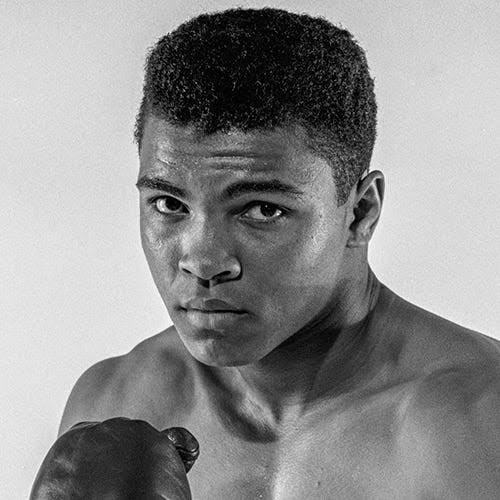
On October 29, 1960, a young man walked into a diner in Louisville, Kentucky, and ordered a hamburger. The waitress refused to serve him. He was black, and the diner was for whites only. He went outside, found a reporter, and told him: "I won the Olympic gold medal for this country, and I can't even get a hamburger here."
That young man was Cassius Clay — soon to be known as Muhammad Ali. He would become the greatest boxer in history, a three-time heavyweight champion of the world, and one of the most important athletes of the 20th century.
But his greatest fight was not in the ring. It was against a government that wanted him to kill people he had never met.
The Boy Who Rode a Bike Cassius Marcellus Clay Jr. was born on January 17, 1942, in Louisville, Kentucky. His father was a sign painter, his mother a domestic worker. The family was poor but proud. Louisville was a segregated city — blacks and whites lived in different neighborhoods, went to different schools, and drank from different water fountains.
At 12, Cassius's bicycle was stolen. He reported it to a policeman named Joe Martin, who also ran a boxing gym. Cassius told him he wanted to beat up the thief. Martin told him: "You better learn to box first."
That was the beginning. Cassius never found his bike. But he found boxing.
He trained obsessively. He woke up early to run. He shadowboxed in the street. He was fast, strong, and fearless. At 18, he won the Olympic gold medal in Rome. He returned home a hero — and then discovered that he still couldn't eat at a whites-only diner.
He threw his gold medal into the Ohio River. He said he didn't want to be a champion of a country that treated him like a second-class citizen. The medal was never found.
The Mouth That Roared Cassius Clay turned professional in 1960. He was loud, brash, and incredibly talented. He predicted his victories in rhyme:
"This guy must be a fool — I'll beat him in four, and make him drool."
He called himself "The Greatest" before he had proved it. He wrote poems about his opponents and recited them at press conferences. The press loved him. The boxing establishment hated him. But he kept winning.
In 1964, he faced Sonny Liston — the most feared heavyweight in the world. Liston was a former convict who had destroyed every opponent. He was 7-1 to beat Clay. Nobody gave Clay a chance.
Clay was terrified. His heart was racing. He was 22 years old, fighting for the heavyweight championship of the world.
He won. Liston quit on his stool after six rounds. Clay was the champion.
That night, he screamed at the press: "I am the greatest! I shook up the world!"
He had not yet shaken the world. He was just getting started.
The Name: Muhammad Ali The morning after beating Liston, Clay announced that he had joined the Nation of Islam — a black separatist religious movement — and that his name was no longer Cassius Clay. It was Muhammad Ali.
The press refused to accept it. They still called him Clay. He insisted: "Cassius Clay is a slave name. I didn't choose it. Muhammad means 'worthy of praise.' Ali means 'the most high.' I am Muhammad Ali."
Some white Americans were outraged. Some black Americans were uncomfortable. But Ali refused to back down. He was not just a boxer. He was a man with a mission.
He said: "I am not a boxer. I am a man who boxes."
The Champion: The Greatest Ali defended his title nine times. He fought the best fighters in the world — Floyd Patterson, George Chuvalo, Henry Cooper, Brian London, Cleveland Williams, Ernie Terrell, Zora Folley. He won every time. He was fast, beautiful, and impossible to hit.
He was not just a great boxer. He was an artist. He floated like a butterfly and stung like a bee. He danced around the ring, dodging punches, and landing combinations that no one could see coming. He was the most beautiful fighter in history.
He said:
"I'm not the greatest. I'm the double greatest. Not only do I knock 'em out, I pick the round."
The Draft: The Fight That Cost Everything In 1967, the United States was at war in Vietnam. Ali was drafted into the army. He refused to go.
He said:
"I ain't got no quarrel with them Viet Cong. No Viet Cong ever called me nigger."
It was one of the most powerful statements of the 20th century. A black athlete — the most famous athlete in the world — was refusing to fight for a country that treated his people as second-class citizens.
The government was furious. The boxing commission stripped him of his title. He was banned from boxing. He was sentenced to five years in prison and fined $10,000. He was free on appeal, but he could not fight.
He lost everything. His title. His money. His career. He was 25 years old — in his prime — and he was banned from the sport he loved.
He said:
"I have nothing to lose by standing up for my beliefs. So I'll go to jail. We've been in jail for 400 years."
The Exile: Three Years of Waiting Ali did not fight for three and a half years. He was stripped of his livelihood. He made money by speaking at colleges and universities. He became a hero to the anti-war movement and to young people who admired his courage.
He was not perfect. He had joined the Nation of Islam, which taught racial separatism. Some of his statements about white people were harsh. He later moderated his views, embraced orthodox Sunni Islam, and said: "I am not a Muslim. I am a human being."
But his courage was undeniable. He sacrificed his career, his money, and his freedom for his beliefs.
He said:
"I don't have to be what you want me to be. I'm free to be what I want."
The Return: The Fight of the Century In 1970, the Supreme Court overturned Ali's conviction. He was free to fight again. He was 28 years old — older, slower, but still Ali.
In 1971, he faced Joe Frazier — the undefeated heavyweight champion — in "The Fight of the Century." It was the most anticipated sporting event in history. Two undefeated champions. Two of the greatest fighters of all time. One winner.
Frazier won. He knocked Ali down in the 15th round with a devastating left hook. Ali got up, but he lost the decision. It was his first professional defeat.
He said:
"I never thought about losing. But it happened. I'm not going to say I'm not hurt. But I'll be back."
He was back. He beat Frazier in a rematch in 1974. Then he faced George Foreman — the most fearsome heavyweight in history — in Zaire, Africa. Foreman was 40-0, with 37 knockouts. He had destroyed Frazier and Norton. He was expected to destroy Ali.
Ali was 32 years old. Everyone said he was washed up. He was the underdog. He was going to lose.
He didn't lose. He used the "rope-a-dope" — leaning on the ropes, covering up, letting Foreman punch himself out. In the eighth round, Ali unleashed a combination that knocked Foreman to the canvas. He was the heavyweight champion of the world again.
He screamed into the microphone: "I told you! I am the greatest! I shook up the world!"
The Thrilla in Manila In 1975, Ali fought Frazier for the third time — in the Philippines. It was one of the most brutal fights in boxing history. Both men were past their prime. Both men hated each other. Both men refused to quit.
Ali won when Frazier's trainer refused to let him come out for the 15th round. Frazier was nearly blind from the punishment. Ali collapsed in his corner, exhausted.
He said:
"It was like death. Closest thing to dying that I know of."
It was the greatest fight in boxing history. It was also the end of an era.
The Final Years: The Greatest Ali fought until 1981. He lost to Leon Spinks in 1978 — a shocking upset — then beat him in a rematch to become the first three-time heavyweight champion of the world. He retired in 1981 with a record of 56 wins, 5 losses, and 37 knockouts.
In 1984, he was diagnosed with Parkinson's syndrome — a neurological condition that slowed his movements and his speech. Some doctors believed it was caused by the punishment he took in the ring. Others said it was genetic.
He did not hide. He became a symbol of courage and dignity. He lit the Olympic flame in Atlanta in 1996 — his hands shaking, his body trembling, but his spirit unbroken. The world wept.
He traveled the world as a humanitarian. He negotiated the release of hostages in Iraq. He raised millions for charity. He was awarded the Presidential Medal of Freedom — America's highest civilian honor.
He died on June 3, 2016, at the age of 74. The world mourned. He was buried in Louisville, his hometown, where the diner that refused to serve him is now a museum.
Lessons from Muhammad Ali's Life Believe in yourself before others do — He called himself "The Greatest" before he had proved it.
Sacrifice for your beliefs — He gave up everything to refuse the draft.
Speed and skill beat power — He out-boxed bigger, stronger opponents.
Use your voice — He was not just a fighter. He was a poet, a prophet, a revolutionary.
Come back from defeat — He lost his title, his career, and his freedom. He won them all back.
Humor is strength — He joked, rhymed, and laughed his way through the toughest fights.
The greatest fight is the one for justice — His refusal to fight in Vietnam was his greatest victory.
Conclusion Muhammad Ali was not just the greatest boxer in history. He was one of the greatest athletes, one of the greatest showmen, and one of the greatest men of the 20th century. He was beautiful, brilliant, and brave.
He said:
"I hated every minute of training, but I said, 'Don't quit. Suffer now and live the rest of your life as a champion.'"
He suffered. He lived as a champion. And he shook up the world.
He was The Greatest. And he still is