Marie Curie: The Woman Who Glowed in the Dark — Two Nobel Prizes and a Sacrifice That Killed Her
The inspiring story of Marie Curie — a poor immigrant woman who was banned from university in her own country, discovered two elements, became the first woman to win a Nobel Prize (and the only person to win it in two sciences), and gave her life to science.
Chronica Editorial · · 12 min read
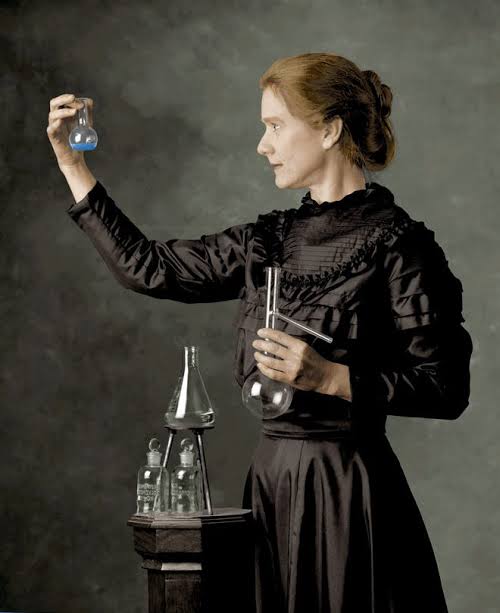
More than 90 years after her death, Marie Curie's notebooks are so radioactive that they are kept in lead-lined boxes. Researchers who want to read them must sign a waiver and wear protective gear. Her body was so full of radiation that her coffin was lined with an inch of lead.
She literally gave her life for science. But before that, she gave science two elements, two Nobel Prizes, and proof that genius has no gender.
A Girl Forbidden to Learn
Maria Skłodowska was born on November 7, 1867, in Warsaw, Poland — a country that did not officially exist. Poland had been swallowed by the Russian Empire, and its people were being forced to forget their language, history, and culture. Polish children were forbidden from speaking Polish in schools.
Maria's father was a physics and math teacher, her mother a school principal — a family of educators crushed under Russian rule. Tragedy struck early: her sister died of typhus, and her beloved mother died of tuberculosis when Maria was just 10. The girl sank into a depression so deep her family feared she would never recover.
But even as a child, Maria was extraordinary. At 15, she graduated at the top of her high school class — with a gold medal.
Then came the wall: women were forbidden from attending university in Poland.
The Flying University and the Sacrifice Deal
Most girls would have accepted their fate — marriage and the kitchen. Maria refused. She joined the "Flying University" — a secret underground school that met in changing locations across Warsaw, taught by banned professors, dodging Russian police. Students risked arrest just to study.
But Maria dreamed of Paris — home of the world's greatest science, the Sorbonne. There was one problem: she had no money.
So she made a legendary deal with her older sister Bronya: Maria would work as a governess and send Bronya to medical school in Paris first. Then Bronya would bring Maria over. For six years, Maria worked in the countryside, teaching rich families' children, sending nearly every coin to her sister, being humiliated by employers, and even falling in love with the family's son — who was rejected by his family because she was too poor.
Meanwhile, she studied chemistry, mathematics, and literature alone at night by candlelight. She wrote to her brother:
"The first condition of happiness is to be united with what I love... science."
In 1891, at age 24, Maria finally boarded a train to Paris. She arrived in a third-class seat, carrying everything she owned.
Bread, Tea, and Genius
Paris was brutal. Maria rented a tiny attic room near the Sorbonne — cold in winter, suffocating in summer. She sometimes fainted from hunger while studying. Her diet was famously miserable: bread, butter, tea, and sometimes just radishes and cherries. One night she forgot to eat and, mid-lesson, fainted in the classroom.
Yet she was unstoppable. She earned a degree in physics — ranked first in her class. A year later, a degree in mathematics — ranked second. She went from a banned woman to outscoring all of Paris.
Pierre: The Meeting of Two Minds
In 1894, a friend introduced Maria to Pierre Curie — a brilliant, quiet physicist who studied crystals and magnetism. Pierre was 35, had never had a serious girlfriend, and considered women a distraction from science.
Maria changed his mind. Their first conversations were about science — and lasted for hours. Pierre later wrote her letters that read like poetry:
"It would be a fine thing to pass our lives near each other, hypnotized by our dreams... your dream: your country and ours; our common dream: humanity's welfare."
They married in 1895 in simple clothes she could wear in the laboratory. Their honeymoon? A bicycle tour of France. It was one of history's greatest scientific love stories — two equals, two minds, one obsession.
Their wedding gift: a bicycle, and money from a friend that Maria used to buy... her first research equipment.
The Shed Where the World Changed
In 1896, a physicist named Henri Becquerel discovered that uranium emitted mysterious invisible rays. The world shrugged. Maria Curie did not. For her doctoral thesis, she chose to answer: what are these rays?
Working in a leaking, muddy shed — described as "a cross between a stable and a potato cellar" — she made a discovery: the radiation came from inside the atom itself. Not a chemical reaction, not a physical process — something deeper than anything science had ever seen. She coined the word for it:
> "Radioactivity."
And then she saw something impossible: two minerals, pitchblende, were more radioactive than pure uranium. Something unknown was hiding inside. Pierre joined her hunt.
In 1898, they announced the discovery of two new elements:
- Polonium — named after Maria's occupied homeland, Poland — a silent act of protest against the Russian Empire - Radium — an element millions of times more radioactive than uranium, and it glowed in the dark, blue-green and beautiful
To prove radium existed, they needed to isolate it. In four years, Maria — by hand, in the pouring rain of the shed — processed several tons of pitchblende ore, stirring boiling chemicals with an iron rod nearly as tall as herself. She recalled later:
I was broken by fatigue... but I was happy. Our precious products, glowing faintly in the darkness of the shed... we passed our evenings stirred by this enchantment.
The image is unforgettable: a woman in a black dress, glowing faintly with blue light, standing in a shed — one of the most romantic and deadliest scenes in scientific history.
1903: The Nobel Prize They Tried to Give Her Husband
In 1903, the Nobel Committee in Stockholm selected Becquerel and Pierre Curie for the Physics Nobel Prize. Marie's name was missing. Her work was the foundation — the committee simply didn't believe a woman had contributed.
Pierre refused to accept without her. He wrote a protest letter: if Marie was not included, he would refuse the prize. The committee blinked. Marie Curie became the first woman in history to win a Nobel Prize.
The couple was too poor to travel to Stockholm — their famous honeymoon gift money, spent years ago, was now matched by friends to send them. On the way, they visited Marie's family in Poland. Crowds followed them in the streets. Marie, who hated publicity, hid from journalists.
The prize money changed their lives — Pierre finally quit his exhausting job, they hired a lab assistant, and adopted a scientist's life. One guest visiting their home described finding them with their young daughter Irène, playing with a cat, in a house with almost no furniture. Marie Curie, world-famous, still owned one good dress.
The Tragedy That Broke Her in Two
On April 19, 1906, crossing a rainy street in Paris, Pierre Curie slipped, fell beneath a heavy horse-drawn cart, and was killed instantly. His skull was crushed. Marie was 38.
The world watched how she would respond. She wrote in her diary — a diary historians still read today:
"Pierre sleeps under the earth now... all my life I shall mourn you. All I have left is the thought of scientific work... without you, how can I go on?"
She went on — in a way no woman ever had. She took over Pierre's professorship at the Sorbonne. The first female professor in the university's 650-year history. Her first lecture, delivered in a quiet voice, picked up exactly where Pierre's last one had stopped — the entire city of Paris came to watch, expecting drama. She gave them physics.
1911: Scandal, Suicide Threats, and a Second Nobel
Then came the storm. In 1911, French newspapers exposed that Marie was having an affair with Paul Langevin — a former student of Pierre's, and a married man. The French press exploded with xenophobia and misogyny: "A foreigner stealing a French husband." Mobs gathered outside her home. Someone threw stones and shouted "Go back to Poland!" The Academy of Sciences rejected her membership by one vote.
The Nobel Committee — even as it prepared to award her a second Nobel Prize — wrote her a letter asking her to not come to Stockholm, believing the scandal was too damaging. It advised her that the prize was for science, not for her private life, and it should stay out of the newspapers.
Marie Curie wrote back one of history's most dignified replies:
"The prize has been awarded for the discovery of radium and polonium. I believe there is no connection between my scientific work and my private life... I cannot accept the idea that this prize should be withheld."
She went anyway. Marie Curie remains the only person in history to win Nobel Prizes in two different sciences — Physics and Chemistry. Not Einstein, not Bohr, not Feynman — only Marie.
Einstein, who knew her personally, wrote:
"Marie Curie is, of all celebrated beings, the only one whom fame has not corrupted."
The Little Curies: A Scientist Goes to War
When World War I erupted in 1914, Marie Curie did something unbelievable. She realized that X-ray machines could save wounded soldiers — and that hospitals near the front lines had none. So she built them.
She convinced the government, converted vehicles into mobile X-ray units, and created what soldiers lovingly called "petites Curies" — Little Curies. She trained herself to drive, learned human anatomy and X-ray operation, and at age 47, drove to the front lines herself — a woman scientist in a war zone, directing X-rays on wounded soldiers, sometimes while shells exploded nearby.
Over a million soldiers were examined by her X-ray units. She also trained 150 women as X-ray technicians. She donated her gold Nobel medals to the war effort — the banks refused to melt them, so she bought war bonds instead. Her daughter Irène, 17, worked alongside her.
The Price of the Blue Glow
Marie Curie spent years handling radioactive materials with no protection — carrying radium vials in her pockets, storing them in her desk, watching them glow by her bed at night. She wrote:
"Radium is an element... it must be beautiful... it glows in the dark, and I love it."
Nobody knew then what radiation does to the human body. Marie's blood slowly destroyed itself. She suffered from cataracts, burns on her fingers, kidney failure, and constant fatigue. On July 4, 1934, she died of aplastic anemia — her bone marrow had been destroyed by decades of radiation exposure.
She had literally been poisoned by her discovery. The blue glow she loved took her life.
But her legacy did not die. Her daughter Irène Joliot-Curie won the Nobel Prize in Chemistry in 1935 — making the Curie family the most decorated in Nobel history (5 prizes in total). Her second daughter Ève wrote her biography, which became a bestseller.
In 1995, France moved her body to the Panthéon — the shrine of France's greatest heroes. Marie Curie became the first woman ever interred there on her own merits. In 2011, her remains were tested; her body was so radioactive that her coffin was lined with lead.
The Greatest Gift: No Patent
Here is perhaps her most beautiful decision. Marie and Pierre discovered how to isolate radium — a process worth millions of dollars. Companies begged to buy it. Pierre was asked if they would patent it.
They refused — completely and voluntarily:
"Radium is an element. It belongs to the people."
They published everything openly, allowing doctors worldwide to use radium in cancer treatment — radiotherapy, which still saves millions of lives today. The Curies could have been billionaires. They chose humanity instead.
Lessons from Marie Curie's Life
1. Don't ask permission to learn — Banned from university, she built her own education in secret. 2. Poverty is not identity — The girl who fainted from hunger out-ranked all of Paris. 3. Sacrifice multiplies success — She supported her sister first; the circle came back to save her. 4. Grief is not the end — She became a legend after losing everything she loved. 5. Dignity beats scandal — When the world attacked her character, she answered with a second Nobel Prize. 6. Knowledge belongs to everyone — She refused patents that could have made her rich forever. 7. Passion has a price — She paid with her life, and saved millions of others in return.
Conclusion
Marie Curie's life is science's most powerful love story — love for a country that rejected her, a science that almost killed her, a husband she lost too soon, and a humanity she served to her final breath.
She once said:
"Nothing in life is to be feared, it is only to be understood. Now is the time to understand more, so that we may fear less."
A century later, every cancer patient receiving radiotherapy, every woman walking into a science lab, every child reading about atoms — all of them live in the glow of the woman from the shed.
She was denied a university, denied her name on the prize, denied respect by an entire nation. She answered with two Nobel Prizes and the discovery of two elements. The world called her a foreigner, a scandal, a danger. History calls her something else: the greatest woman scientist who ever lived.
What inspires you most about Marie Curie — her genius, her sacrifice, or her refusal to give up? Share your thoughts in the comments below!