Leonardo da Vinci: The Illegitimate Boy Who Couldn't Attend School — And Became the Smartest Human Ever
The extraordinary story of Leonardo da Vinci — an illegitimate village boy with no formal education who became the greatest painter, inventor, anatomist, and engineer in history, 500 years before his ideas changed the world.
Chronica Editorial · · 12 min read
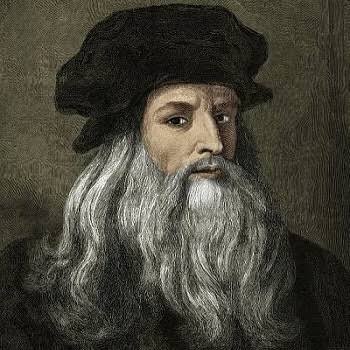
In 1519, a 67-year-old man lay dying in a French chateau. He asked his servants to bring his notebooks — thousands of pages filled with flying machines, dissected hearts, and unfinished paintings. He wept, apologizing that he had not done more with his life.
That man had painted the most famous painting in human history. He had designed a helicopter 450 years before the first airplane flew. He had drawn the human heart so accurately that modern heart surgeons still use his sketches.
He was Leonardo da Vinci — and he still felt he had failed. That is how far ahead of his time he was.
Born Outside the Door
Leonardo was born on April 15, 1452, near the town of Vinci, in the hills of Tuscany, Italy. His father, Ser Piero, was a wealthy lawyer. His mother, Caterina, was a young peasant woman — possibly a servant or slave.
They were not married. Leonardo was illegitimate — and in 15th-century Italy, that word defined your entire life. He could not join the legal profession like his father. He could not attend university. He was excluded from the "respectable" paths of society. He received almost no formal education — no Latin, no Greek, no mathematics taught in schools. Historians call him "da Vinci the outsider."
But this exclusion became his superpower. Because he never attended school, Leonardo never learned the "approved" way of thinking. He would spend his whole life learning directly from nature — observing, testing, questioning — instead of trusting old books. He later called himself a "discepolo della sperienza" — a disciple of experience.
He would write in defense of his lack of Latin — the language of scholars:
"I am a man without letters... but I will cite greater things — experience — as my mistress."
While scholars quoted ancient books, Leonardo looked at birds and asked: how does the wing work? While priests repeated theories, Leonardo opened corpses and asked: what is actually here?
The Dragon Shield: First Sign of a Genius
As a boy, Leonardo wandered the Tuscan countryside — collecting lizards, snakes, butterflies, and bats. His father, noticing his son's love for drawing, one day took a wooden shield to a friend and asked young Leonardo to paint something on it.
Leonardo painted a monster so terrifying — assembled from the faces of lizards, bats, and snakes he had studied — that when his father saw it, he stumbled backward in shock. He was so impressed he secretly sold the shield to a merchant, and bought his son a cheaper one.
The legend of Leonardo had begun.
Verrocchio's Workshop: The Angel That Broke a Master
Around age 14, his father showed his son's drawings to Andrea del Verrocchio — the greatest artist in Florence. Verrocchio took the boy in immediately as an apprentice.
In Florence's workshop, Leonardo learned everything: painting, sculpture, metalwork, chemistry, engineering, carpentry. The workshop was a factory of the Renaissance — and Leonardo was becoming its sharpest blade.
Then came the moment that became legend. Around 1472, Verrocchio assigned his young student to paint an angel in his painting The Baptism of Christ. Leonardo's angel — kneeling, with flowing golden hair and an otherworldly softness — was so breathtakingly superior to the master's own figures that, according to the famous story, Verrocchio put down his brush and never painted again.
Whether literally true or not, the message was clear: a force had arrived.
At 20, Leonardo was registered in the Guild of Saint Luke — the official guild of master painters. A full master, young and rising.
The Notebooks: 7,000 Pages of the Future
Leonardo left behind something no artist had ever left: more than 7,000 pages of notes and drawings — his private notebooks, written in his famous mirror writing (right to left, readable only in a mirror).
Why mirror writing? Not magic — he was left-handed, and writing this way prevented smudging ink. But some also believe he kept his ideas secret, or simply enjoyed the puzzle.
Inside those notebooks, humanity later discovered:
- The aerial screw — the ancestor of the helicopter - A designed parachute — 500 years later, a skydiver built it and it actually worked - An armored tank — a circular war machine powered by men turning cranks - A diving suit — with breathing tubes for underwater warfare - A mechanical knight — a robot with gears that could sit up and wave its arms - Self-propelled cart — essentially the blueprint for a car/robot vehicle - Anatomical sketches of hearts, skulls, fetuses, and muscles so precise that modern medical imaging confirmed them - Studies of water flows, light, birds, plants, clouds — nothing escaped him
He wrote questions in his notebooks like a man possessed:
Why is the sky blue? How do birds fly? Describe the tongue of the woodpecker.
Yes — he actually wrote a task for himself: describe the tongue of the woodpecker. No one in history was curious about so many things at once. Biographer Walter Isaacson called him the most curious human who ever lived.
The Corpse Room: The Scientist Hidden in the Artist
Between 1489 and 1513, Leonardo claimed in his notes to have dissected more than 30 human corpses — by candlelight, in hospitals' morgues, alone with the dead.
Why? To answer one question: what is a smile, physically? He wanted to know which muscles moved when a human smiled — so he could paint truth instead of guessing.
What he found rewrote medicine. He drew the heart with its four chambers, described atherosclerosis (hardened arteries) 150 years before official medicine did, and made a glass model of the aortic valve to study blood flow — an experiment confirmed by modern scientists as correct.
Then, quietly, he wrote the sentence that should have changed medicine forever:
The heart, rather than being the seat of the soul, is a muscle... and the soul is not in the heart.
He was centuries early. The world wasn't ready — most of his anatomical discoveries remained hidden in notebooks, unpublished, until long after his death. This is the great tragedy of Leonardo: he discovered the future, but never published it.
The Last Supper: Painting That Stopped Time
In 1495, the Duke of Milan gave Leonardo a wall in the refectory (dining hall) of the Santa Maria delle Grazie monastery — and asked for a painting of Jesus's final meal with his disciples.
What Leonardo created broke every rule of painting. Instead of the stiff, separated disciples of tradition, he painted one frozen explosive moment — the exact second after Jesus announces: "One of you will betray me." Thirteen men erupt in waves of shock, denial, anger, grief — each face a psychological novel.
Leonardo worked unlike any painter. He would stand before the wall for hours without painting a single stroke — just staring, thinking. Monks complained. He would suddenly rush in, climb the ladder, add one stroke, and leave. He even painted the face of Judas using real prisoners' faces for study. He wandered Milan for days looking for the perfect face for Christ — and never found one he fully approved of, leaving parts unfinished.
When completed, The Last Supper made Leonardo the most famous artist in Italy. Visitors came from across Europe just to stare at a wall. Kings begged for copies.
Tragically, Leonardo's experimental technique (he hated fresco's speed, so he used his own mix) began peeling within his lifetime. The painting has survived bombs in World War II, dampness, restorers — and still, today, 500 years later, thousands queue daily in Milan to see it, forbidden to even breathe too much near it.
Mona Lisa: The Smile He Never Delivered
Around 1503, a Florentine silk merchant named Francesco del Giocondo commissioned a portrait of his wife, Lisa Gherardini — a modest 24-year-old woman.
Leonardo took the portrait... and never gave it back. He worked on it for 16 years, carrying it from city to city, adding layer upon translucent layer, refining the smile, never declaring it finished.
Why is the Mona Lisa the most famous painting on Earth?
- The smile — Leonardo's anatomical obsession paid off. The smile appears and disappears depending on where your eyes look. Modern science calls it the uncatchable smile — he painted it in soft shadow layers that trick peripheral vision. - Sfumato — his signature technique: no hard lines, everything dissolving like smoke ("sfumato" means vanished like smoke). There is no outline around her face. She feels alive. - The eyes follow you — wherever you stand, she watches.
In 1911, an Italian handyman stole the painting from the Louvre — and the theft made the Mona Lisa a global superstar. Crowds lined up to see the empty space on the wall. When recovered two years later, it was no longer a painting — it was the painting.
Today, over 10 million people a year visit the Louvre — most just to see her. She is insured as priceless; in 1962 her value was assessed at $100 million — nearly $1 billion today.
And Leonardo? He refused to hand her over. He kept her until his dying day.
The Unfinished Man
Here is the surprising truth: Leonardo — the greatest genius ever — was also history's most famous procrastinator. He rarely finished anything:
- The Sforza Horse — a planned 24-foot bronze horse, the largest ever — was never cast (the clay model was destroyed by French soldiers using it as target practice) - The Battle of Anghiari — his grandest painting, abandoned mid-wall - Adoration of the Magi — unfinished - Saint Jerome in the Wilderness — unfinished - Countless commissions, engineering projects, and treatises — abandoned
He wrote guiltily in his own notebook:
"Tell me if anything was ever done... Tell me if ever I have done a thing."
He was easily distracted — a new curiosity could hijack him mid-project. His patrons complained constantly. Pope Leo X, who employed him, reportedly sighed: "This man will never accomplish anything! He thinks of the end before the beginning!"
Yet in his distraction lay his power. He didn't see "painting" and "engineering" and "anatomy" as separate jobs — to him, it was one single subject: understanding the world. The man who studied rivers painted flowing hair. The man who dissected faces painted the Mona Lisa. The man who watched birds designed flying machines.
He believed, above all:
"Learning never exhausts the mind."
And:
"Obstacles cannot crush me. Every obstacle yields to stern resolve. He who is fixed to a star does not change his mind."
The King's Guest: A Gentle Ending
In 1516, at age 64, Leonardo received an invitation most artists dream of: Francis I, the King of France, offered him the official title of "First Painter, Engineer, and Architect to the King" — plus a generous salary and a beautiful manor, Château du Clos Lucé, right next to the royal palace.
Leonardo accepted, crossed the Alps on a mule — with his notebooks and, legend says, the Mona Lisa in his luggage — and spent his final years in France as an honored guest. The young king visited him constantly; the two talked for hours like grandfather and grandson.
On May 2, 1519, Leonardo died. A romantic legend claims he died in the king's arms. Whether true or embellished, the king genuinely mourned him.
He was buried in the chapel of Château d'Amboise. His notebooks — those 7,000 pages of the future — were scattered across Europe, hidden, sold, and lost for centuries. In 1994, Bill Gates bought one of Leonardo's notebooks, the Codex Leicester, for $30.8 million — the most expensive book ever sold.
And in 2017, his painting Salvator Mundi was auctioned for $450 million — the most expensive artwork ever sold in human history. Both records belong to one man, 500 years after his death.
Lessons from Leonardo da Vinci's Life
1. Curiosity is the real genius — He wasn't born smart; he was born asking. The woodpecker's tongue matters to someone who refuses to stop wondering. 2. Being an outsider is an advantage — He couldn't attend university, so he invented his own education. No boxes = no limits. 3. Learn from nature, not just books — "Experience" was his teacher. Observation beats theory when they disagree. 4. Everything is connected — Art informed science; science informed art. Specialize if you must, but never stop crossing borders. 5. Unfinished is human — Even the greatest genius left works incomplete. Progress matters more than perfection. 6. Keep notebooks — 7,000 pages of thinking outlived him and changed the world. Write your ideas down. 7. Time reveals value — The world wasn't ready for Leonardo in 1519. It's still catching up in 2025.
Conclusion
Leonardo da Vinci is proof that the words "artist," "scientist," and "engineer" are just labels humans invented — and genius ignores them all.
An illegitimate boy, denied schooling, excluded from society, stood alone against the horizon of human knowledge and walked further than anyone before him. Five hundred years later, we are still reading his notes, still restoring his paintings, still building the machines he imagined.
He called himself "a man without letters." History calls him the most talented human being who ever lived.
He left us his secret, written in his own notebook, as advice for everyone who came after:
"I have been impressed with the urgency of doing. Knowing is not enough; we must apply. Being willing is not enough; we must do."
And perhaps the most beautiful of all:
"Simplicity is the ultimate sophistication."
Which side of Leonardo amazes you most — the artist, the scientist, or the inventor? Tell us in the comments below!