Isaac Newton: The Man Who Discovered the Laws of the Universe
The incredible story of Isaac Newton — the boy who was born premature and not expected to survive, who discovered gravity, invented calculus, unraveled the mysteries of light, and wrote the most important scientific book in history.
Chronica Editorial · · 8 min read
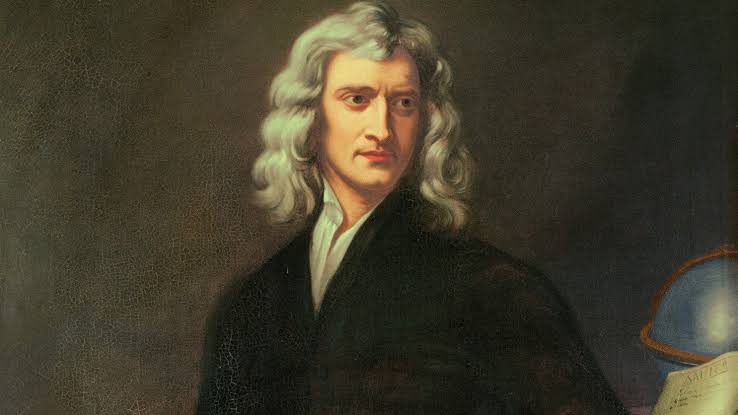
In 1665, a young man was forced to leave his university because of a plague outbreak. He returned to his family's farm in the English countryside, where he spent two years doing almost nothing but thinking. Those two years — which he called his "year of wonders" — changed the course of human history.
He discovered the laws of motion. He discovered the law of universal gravitation. He discovered the nature of light and color. He invented calculus. He was 23 years old.
His name was Isaac Newton. He would become the greatest scientist who ever lived — the man who unlocked the secrets of the universe.
The Boy Who Wasn't Supposed to Live Isaac Newton was born on December 25, 1642 — in the same year that Galileo died. He was born prematurely, so small that, as he later said, "they might have put me into a quart mug." Nobody expected him to survive. But he did.
His father had died three months before he was born. His mother remarried when Isaac was three and left him to be raised by his grandmother. He never forgave her. He later listed the abandonment among his sins — a sign of his deeply troubled personality.
He was a lonely, angry, and brilliant child. At school, he was not a star student. But he was fascinated by mechanical devices — he built windmills, water clocks, and sundials. He was obsessed with understanding how things worked.
At 16, his mother pulled him out of school to manage the family farm. He was a terrible farmer — he spent his time reading and building models instead of tending the crops. His uncle intervened and convinced his mother to send him back to school. It was one of the luckiest decisions in history.
Cambridge and the Plague Years In 1661, Newton entered Trinity College, Cambridge. He was older than most students, poorer than most, and more serious than almost anyone. He devoured Aristotle, Descartes, Galileo, and Kepler. He read everything he could find on mathematics, astronomy, and physics.
But in 1665, the Great Plague broke out in London. The university shut down. Newton returned to his home in Woolsthorpe — and there, in two short years, he made discoveries that would change everything.
He later said:
"All this was in the two plague years of 1665-1666. For in those days I was in the prime of my age for invention and minded mathematics and philosophy more than at any time since."
The Discovery of Gravity The story is famous — perhaps too famous. Newton was sitting under an apple tree when an apple fell. He wondered: why does the apple fall straight down, while the moon stays in the sky? Why doesn't the moon fall to Earth?
The answer was gravity — a universal force that pulls all objects toward each other. The same force that pulls the apple to the ground keeps the moon in orbit around the Earth. The same force that keeps the planets in orbit around the sun.
Newton realized that gravity was not just a force on Earth — it was a force everywhere, binding the entire universe together. He was the first person in history to understand that the same laws that govern the fall of an apple also govern the movement of planets.
He said:
"If I have seen further it is by standing on the shoulders of giants."
He didn't invent the idea of gravity. But he discovered that gravity was universal, and he gave it a mathematical formula that explained everything.
The Laws of Motion Newton also formulated three laws of motion that explained how all objects move:
The Law of Inertia — An object at rest stays at rest, and an object in motion stays in motion, unless acted on by a force.
The Law of Acceleration — Force equals mass times acceleration (F=ma).
The Law of Action and Reaction — For every action, there is an equal and opposite reaction.
These three laws explained everything from the movement of planets to the trajectory of a cannonball. They were the foundation of physics for over 200 years. They are still used today.
The Nature of Light Newton was also fascinated by light. He passed a beam of sunlight through a glass prism and saw it split into a rainbow of colors. He concluded that white light is not pure — it is a mixture of all the colors of the spectrum.
He also invented a new type of telescope — the reflecting telescope — which used a mirror instead of a lens to avoid the problem of color distortion. His telescope was much smaller and more powerful than any existing telescope. He built it himself. It is still preserved today at the Royal Society in London.
The Calculus Controversy Newton invented calculus — a branch of mathematics that studies change and motion. It was his greatest mathematical achievement, and it was essential for his physics.
But Newton was not alone. Gottfried Wilhelm Leibniz, a German mathematician, also invented calculus — independently, and at roughly the same time. When Leibniz published his version first, Newton was furious. He believed Leibniz had stolen his ideas.
The controversy became one of the most bitter disputes in the history of science. The two men and their followers attacked each other for decades. Newton eventually won — but his reputation was scarred by his ruthless behavior.
The Principia: The Greatest Science Book Ever Written In 1687, Newton published his masterpiece: Philosophiæ Naturalis Principia Mathematica — the Mathematical Principles of Natural Philosophy. It is widely considered the greatest scientific book ever written.
In it, Newton laid out his laws of motion and his law of universal gravitation. He explained the movements of planets, moons, comets, and tides. He proved that the universe was governed by mathematical laws — not by the whims of the gods.
The book was difficult. It was written in Latin. It was full of complex mathematics. But it was revolutionary. It changed how humans understood the universe. It made science the most powerful tool for understanding reality.
The Later Years: Alchemy, Theology, and a Nervous Breakdown Newton's later life was strange. He suffered a nervous breakdown in 1693 — possibly due to mercury poisoning from his alchemy experiments. He spent years studying alchemy — the quest to turn base metals into gold — and theology — writing thousands of pages about the Bible and early church history.
He was a deeply religious man — but his beliefs were unorthodox. He rejected the doctrine of the Trinity and believed that the Catholic Church had corrupted Christianity. He kept these beliefs secret. If they had become public, he would have been ruined.
He became Warden of the Royal Mint in 1696 and Master in 1700. He was a strict and effective administrator. He reformed the currency, introduced the gold standard, and hunted down counterfeiters. He was knighted in 1705 — the first scientist to be honored in this way.
He was elected President of the Royal Society in 1703 and served until his death. He was a tyrant in that role — he controlled everything, silenced his enemies, and destroyed anyone who questioned him.
He was not a nice man. He was jealous, vindictive, and paranoid. He never married. He had few friends. He died alone.
But he was the greatest genius who ever lived.
The Final Days Isaac Newton died on March 31, 1727, at the age of 84. He was buried in Westminster Abbey — the first scientist to be given this honor.
On his deathbed, he said:
"I do not know what I may appear to the world, but to myself I seem to have been only like a boy playing on the seashore, and diverting myself in now and then finding a smoother pebble or a prettier shell than ordinary, whilst the great ocean of truth lay all undiscovered before me."
He saw himself as a child, playing with pebbles on the beach. But the ocean of truth that lay before him — he discovered more of it than anyone before or since.
Lessons from Isaac Newton's Life Hard work beats talent — He was not a prodigy. He worked obsessively.
Isolation can be productive — His plague years changed the world.
Question everything — He did not accept the accepted truths. He tested them.
Mathematics is the language of nature — He discovered the laws of the universe through math.
Genius has a dark side — He was brilliant, but also jealous, cruel, and paranoid.
Humility in the face of truth — He saw himself as a child playing on the beach.
Your legacy outlives your flaws — We remember his genius, not his cruelty.
Conclusion Isaac Newton did not just discover gravity. He discovered the rules of the universe. He proved that nature operates by mathematical laws that can be understood by human minds. He gave us the tools to predict the movement of planets, the trajectory of comets, and the rise and fall of tides.
He was not a saint. He was a difficult, tormented, brilliant man. But he was the greatest scientist who ever lived.
He said:
"To every action there is always opposed an equal reaction."
The universe reacts. It obeys laws. And Isaac Newton was the man who found them.