Galileo Galilei: The Man Who Defied the Church and Proved the Earth Moves
The story of Galileo Galilei — the father of modern science who improved the telescope, discovered Jupiter's moons, proved the Earth revolves around the sun, and was forced to deny his own discoveries by the Inquisition.
Chronica Editorial · · 8 min read
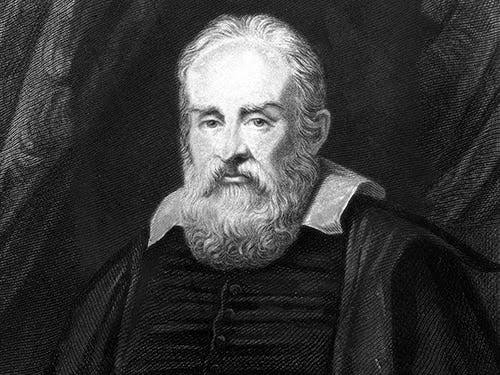
On a spring evening in 1610, a man pointed a small tube of glass and wood at the night sky and saw something no human had ever seen before: moons circling another planet. Jupiter — the giant of the solar system — was not a solitary wanderer. It had its own family of moons.
If moons circled Jupiter, then not everything in the universe circled the Earth. The ancient, sacred cosmology was wrong. The Earth was not the center of everything.
That man was Galileo Galilei. He was not the first to suggest that the Earth moved — Copernicus had done that decades earlier. But Galileo was the first to prove it with observations. And for that, he was put on trial by the Inquisition — the most feared court in Europe.
This is the story of the man who defied the church, changed science forever, and was forced to say that the truth was a lie.
The Boy from Pisa Galileo Galilei was born on February 15, 1564, in Pisa, Italy. His father was a musician and music theorist who challenged the accepted rules of harmony. That spirit of questioning authority ran in the family.
Galileo enrolled at the University of Pisa to study medicine, but he was more interested in mathematics and physics. He was brilliant but argumentative. He earned the nickname "The Wrangler" because he loved to argue.
He never finished his degree. He left the university without graduating and began studying mathematics on his own. He became a professor of mathematics at Pisa in 1589, then at the University of Padua in 1592 — one of the most prestigious universities in Europe.
His early work was on motion. He dropped objects of different weights from towers and rolled balls down inclined planes. He discovered that all objects fall at the same rate regardless of their weight — a revolutionary idea that contradicted Aristotle, the ancient authority that everyone followed.
He also discovered the law of the pendulum, the principle of inertia, and the parabolic trajectory of projectiles. He was laying the groundwork for modern physics.
The Telescope: A New Window on the Universe In 1609, Galileo heard about a Dutch invention — a "spyglass" that made distant objects appear closer. He didn't see one, but he understood the principle immediately. He built his own telescope — grinding lenses himself, improving the design until it could magnify objects 20 times.
His telescope was far better than anything the Dutch had built. He turned it to the sky — and what he saw changed the universe.
He saw:
The Moon had mountains and craters — not a perfect, smooth sphere as Aristotle had taught.
Jupiter had four moons — Io, Europa, Ganymede, and Callisto — circling it, proving that not everything revolved around the Earth.
Venus had phases — like the Moon — which proved it orbited the sun, not the Earth.
The Milky Way was made of countless stars — not a blurry band of light.
He published his discoveries in a book called Sidereus Nuncius — "The Starry Messenger." It made him famous across Europe. He was appointed chief mathematician to the Grand Duke of Tuscany — a prestigious position that gave him protection and money.
But his discoveries also made him enemies. The Catholic Church taught that the Earth was the center of the universe — that the sun, moon, and planets all revolved around us. Galileo's observations contradicted that teaching.
The Copernican Revolution In 1543, a Polish astronomer named Nicolaus Copernicus had published a book arguing that the Earth revolved around the sun, not the other way around. The Church had tolerated the idea as a mathematical convenience — a way to calculate planetary positions — but not as physical truth.
Galileo believed it was physical truth. His observations confirmed it. He began to argue publicly that the Earth moved.
This was dangerous. The Church had condemned Copernicanism as "false and contrary to Scripture." In 1616, the Inquisition placed Copernicus's book on the Index of Forbidden Books. Galileo was warned not to defend or promote Copernicanism.
He obeyed — for a while. He went silent on the subject and continued his scientific work. He developed a new method of determining longitude at sea, studied sunspots, and worked on the problem of motion.
The Dialogue: The Book That Got Him in Trouble In 1632, Galileo published his most famous book: Dialogue Concerning the Two Chief World Systems. It was a conversation between three characters — one defending the Copernican system, one defending the Ptolemaic system, and one neutral observer. The book was brilliant, witty, and convincing. The Copernican character clearly won the argument.
The book was a sensation. But it was also a disaster for Galileo. The Pope, Urban VIII — who had once been a friend and admirer of Galileo — was furious. He believed Galileo had mocked him by putting the Pope's own arguments into the mouth of the fool character.
The Inquisition summoned Galileo to Rome. He was 68 years old, sick, and fragile. He was accused of heresy — of teaching that the Earth moved, and that the Bible was wrong.
He was put on trial.
The Trial and the Abjuration The trial lasted two months. Galileo was interrogated, threatened with torture, and shown the instruments. He was not tortured — he was too old and famous — but he was terrified.
The Inquisition demanded that he renounce his beliefs. On June 22, 1633, in the church of Santa Maria sopra Minerva in Rome, Galileo knelt and read a statement:
"I, Galileo, son of the late Vincenzo Galilei, Florentine, aged seventy years, arraigned personally before this tribunal, and kneeling before you... swear that I have always believed, do now believe, and with God's help will in the future believe all that is held, preached, and taught by the Holy Catholic and Apostolic Church. But whereas I have been suspected of heresy... I abjure, curse, and detest the said errors and heresies."
He was sentenced to life imprisonment — which was later commuted to house arrest. He spent the rest of his life confined to his villa in Arcetri, near Florence.
The legend says that as he rose from his knees, he muttered: "E pur si muove" — "And yet it moves." Whether he actually said it or not, it became the most famous phrase in the history of science — a defiant whisper against authority.
The Final Years: Science in Captivity Galileo was not broken. Under house arrest, he wrote his greatest scientific work: Discourses and Mathematical Demonstrations Concerning Two New Sciences. It was a summary of his life's work on motion, materials, and the laws of physics. He secretly smuggled the manuscript out of Italy to be published in Holland in 1638.
The book laid the foundation for modern physics. Newton would build on it. Einstein would honor it. It is one of the most important scientific books ever written.
Galileo's health declined. He lost his sight in 1637 — a tragic end for a man who had spent his life looking at the stars. He died on January 8, 1642, at the age of 77.
The Church refused to bury him in consecrated ground. He was buried in a small chapel in the Basilica of Santa Croce in Florence, without a monument. In 1737, his remains were moved to a grander tomb, and a monument was finally erected in his honor.
In 1992, Pope John Paul II issued a declaration acknowledging that the Church had made a mistake in condemning Galileo. It took 359 years. But the truth — "e pur si muove" — had long since won.
Lessons from Galileo Galilei's Life Observation beats authority — He looked at the sky and saw what no one had seen.
Question what everyone believes — He challenged Aristotle and the Church.
Build your own tools — He made his telescope better than anyone else's.
Truth cannot be imprisoned — He wrote his greatest work under house arrest.
Courage is not always loud — Sometimes it is a whispered "e pur si muove."
Science is patient — It took 359 years for the Church to admit its error.
The universe is bigger than dogma — The Earth moves. Nothing can change that.
Conclusion Galileo Galilei was the first scientist in the modern sense — a man who used observation, experiment, and mathematics to understand the world. He was not just a philosopher. He was a builder, a maker, a measurer.
He defied the most powerful institution in Europe and paid the price. But his ideas could not be silenced. He gave us the telescope, the law of falling bodies, the moons of Jupiter, and the first great battle between science and authority.
He said:
"I do not feel obliged to believe that the same God who has endowed us with sense, reason, and intellect has intended us to forgo their use."
He used his sense, his reason, and his intellect. He saw the truth. And the truth set the universe free.