Benjamin Franklin: The Man Who Invented the Future
The extraordinary life of Benjamin Franklin — the printer, scientist, inventor, diplomat, and founding father who discovered electricity, invented the lightning rod, bifocals, and the Franklin stove, and helped create the United States of America.
Chronica Editorial · · 8 min read
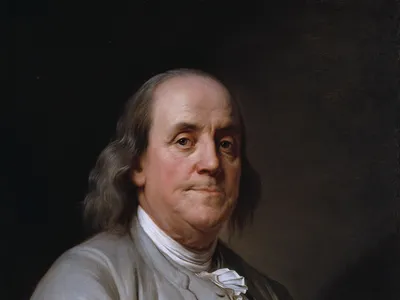
In 1752, a man flew a kite in a thunderstorm. He attached a metal key to the string and watched as sparks jumped from the key to his hand. He had just proved that lightning was electricity — one of the most dangerous experiments in scientific history.
He could have been killed. Several people who tried to repeat the experiment were. But Benjamin Franklin survived — and became one of the most famous scientists in the world.
But science was just one part of his life. He was also a printer, a writer, an inventor, a diplomat, a philosopher, and one of the founding fathers of the United States. He signed the Declaration of Independence, the Treaty of Paris, and the Constitution. He was the only person to sign all four of the key documents that created America.
He was the most versatile genius in American history.
The Runaway Apprentice Benjamin Franklin was born on January 17, 1706, in Boston. He was the fifteenth of seventeen children. His father was a candle maker, and the family was poor. Benjamin had only two years of formal schooling before he was put to work in his father's shop.
At 12, he was apprenticed to his brother James, a printer. It was a harsh apprenticeship. James beat him and treated him badly. But Benjamin learned the printing trade — and he learned to read and write. He devoured books, reading everything he could borrow or buy.
He also learned to write by imitating the essays in The Spectator, a popular magazine. He would read an essay, put it away, and try to rewrite it from memory. Then he would compare his version with the original and correct his mistakes. It was a brilliant method of self-education.
At 16, he wrote a series of essays under the pen name "Silence Dogood" — a fictional middle-aged widow who criticized the government and society. The essays were published in James's newspaper without James knowing who wrote them. When he found out, he was furious.
Benjamin ran away.
The Printer of Philadelphia At 17, Benjamin arrived in Philadelphia with almost nothing — a few coins in his pocket and a loaf of bread under his arm. He slept in a boarding house and found work as a printer. He was ambitious, hardworking, and charming.
He went to London to buy printing equipment, stayed for two years, and returned to Philadelphia to start his own printing business. He published The Pennsylvania Gazette — one of the most successful newspapers in the colonies. He also published Poor Richard's Almanack — a yearly almanac filled with weather predictions, proverbs, and practical advice.
Poor Richard's Almanack made him rich. It sold 10,000 copies a year — a huge number at the time. His proverbs became famous:
"Early to bed, early to rise, makes a man healthy, wealthy, and wise."
"A penny saved is a penny earned."
"God helps those who help themselves."
"Time is money."
He became the most successful printer in America. He retired at 42 — wealthy enough to spend the rest of his life on science, politics, and public service.
The Scientist: Electricity and Light Franklin was fascinated by electricity. In the 1740s, it was a mysterious force that scientists could generate with friction machines but did not understand. Franklin experimented obsessively. He discovered that electricity had positive and negative charges. He invented the terms "battery," "conductor," and "charge."
His most famous experiment was the kite in the thunderstorm. He attached a metal key to the string of a kite and flew it during a storm. Sparks jumped from the key to his hand — proving that lightning was electricity. It was a dangerous and brilliant experiment.
He then invented the lightning rod — a metal rod attached to a building and connected to the ground by a wire. The rod would attract lightning and conduct it safely to the ground, preventing fires and saving lives. It was one of the most practical inventions in history.
He also invented:
The Franklin stove — a more efficient wood-burning stove that produced more heat with less fuel.
Bifocals — glasses with two lenses, one for near vision and one for far vision. He invented them because he was tired of switching between two pairs of glasses.
The armonica — a musical instrument made of glass bowls that produced haunting music. Mozart and Beethoven composed for it.
The flexible urinary catheter — a medical device he invented for his brother.
He was a member of the Royal Society and received its highest honor, the Copley Medal, for his work on electricity. He was one of the most famous scientists in the world.
The Diplomat: The Fight for Independence Franklin was also a passionate political thinker. He served in the Pennsylvania Assembly and represented the colonies in London for many years. He argued against the Stamp Act and other British taxes. He was initially loyal to the British Crown — he wanted the colonies to have representation in Parliament, not independence.
But as Britain became more repressive, Franklin changed his mind. He returned to America in 1775 and was elected to the Second Continental Congress. He helped draft the Declaration of Independence — though Thomas Jefferson wrote most of it. He signed it at the age of 70 — the oldest signer.
In 1776, Franklin was sent to France as America's ambassador. His mission was to convince the French to support the American Revolution. He was a celebrity in France — the famous scientist, the simple Quaker from America. He wore a fur cap, spoke French badly, and charmed everyone he met.
He succeeded. France signed a treaty of alliance with America in 1778 and provided money, soldiers, and ships. The French support was crucial to the American victory.
He also negotiated the Treaty of Paris in 1783, which ended the war and recognized American independence. He was one of the most effective diplomats in American history.
The Founding Father Franklin returned to America in 1785. He was 79 years old. He should have retired. Instead, he helped write the Constitution of the United States in 1787. He was the oldest delegate at the Constitutional Convention.
He was a voice of compromise and moderation. He helped resolve the great debates between large and small states, and between slave and free states. He was not perfect — he owned slaves for much of his life, though he later became an abolitionist and freed them.
He signed the Constitution and urged others to do the same:
"I agree to this Constitution with all its faults, if they are such, because I think a general government is necessary for us."
He was the only person to sign all four of the founding documents: the Declaration of Independence, the Treaty of Paris, the Treaty of Alliance with France, and the Constitution.
The Final Years Franklin died on April 17, 1790, at the age of 84. He was one of the most famous men in the world. His funeral was attended by 20,000 people — the largest funeral in America at that time.
He wrote his own epitaph:
"The Body of B. Franklin, Printer; like the Cover of an old Book, its Contents torn out, and stript of its Lettering and Gilding, lies here, Food for Worms. But the Work shall not be wholly lost; for it will, as he believ'd, appear once more, in a new & more perfect Edition, Corrected and Amended By the Author."
He saw himself as a book — worn out, but waiting for a new edition. He believed in progress, in improvement, in the future.
Lessons from Benjamin Franklin's Life Educate yourself — He had two years of school and became one of the most educated men in the world.
Work hard — He built a printing empire through discipline and effort.
Curiosity is power — He experimented with electricity, invented devices, and changed science.
Serve your community — He founded libraries, fire departments, and universities.
Diplomacy matters — He convinced France to save the American Revolution.
Compromise is strength — He helped create the Constitution by finding common ground.
Never stop learning — He was inventing and writing until the end of his life.
Conclusion Benjamin Franklin was the first great American — a self-made man who rose from poverty to become a scientist, inventor, diplomat, and founding father. He embodied the American Dream before America even existed.
He said:
"An investment in knowledge pays the best interest."
He invested in himself. He invested in his country. He invested in the future. And the interest he paid the world was immense.
He invented the lightning rod that saved countless lives. He helped create the United States of America. He proved that lightning was electricity — and that one man could change everything.
He was a printer, a scientist, a diplomat, and a revolutionary. He was Benjamin Franklin. And he invented the future.