Alexander Graham Bell: The Man Who Taught the World to Talk Across Wires
The story of Alexander Graham Bell — the teacher of the deaf who invented the telephone, changed communication forever, and spent his life helping people with hearing loss.
Chronica Editorial · · 7 min read
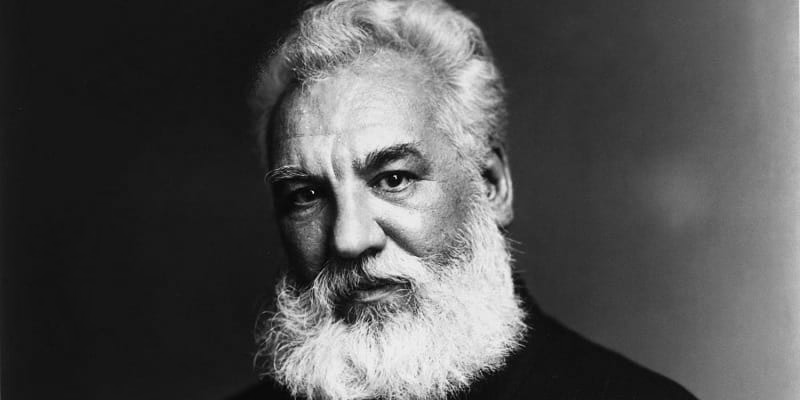
On March 10, 1876, in a small laboratory in Boston, a man pressed his lips to a metal mouthpiece and spoke a sentence that would change human history. The words were simple. The words were mundane. But what happened after them was magic.
"Mr. Watson, come here. I want to see you."
Across the hallway, in a separate room, Thomas Watson heard the voice coming from the receiver. He had not heard the voice through the wall. He had heard it through a wire. It was the first telephone call in history.
The man was Alexander Graham Bell. He was not a physicist, not an engineer, not an inventor by training. He was a teacher of the deaf. His life's passion was helping people hear. His invention, the telephone, made the whole world hear.
The Boy Who Talked to the World Alexander Graham Bell was born on March 3, 1847, in Edinburgh, Scotland. His family was obsessed with speech and sound. His grandfather was a famous elocutionist. His father, Alexander Melville Bell, was a teacher of elocution who developed "Visible Speech" — a system of symbols that represented all the sounds of human language, allowing deaf people to learn to speak.
But the family also carried a tragedy. Alexander's mother was deaf. She could only hear with the help of a hearing tube. When Alexander spoke to her, he learned to speak slowly and clearly. He learned to press his lips against her forehead so she could feel the vibrations of his voice.
His mother's deafness gave him his life's mission: helping people with hearing loss communicate.
Alexander, called "Aleck," was an average student in most subjects. He was bored by Latin and Greek. But he was fascinated by science and speech. At 16, he joined his father in the family business — teaching elocution and speech to the deaf.
Tragedy struck the family. Two of his brothers died of tuberculosis — one in 1867, another in 1870. Alexander, always the fragile one, was taken by his parents to Canada in 1870 in the hope that the clean air would save him. It did.
The Teacher of the Deaf In 1871, Alexander moved to Boston to work at the Clarke School for the Deaf. He taught deaf children to speak using his father's Visible Speech system. He was a dedicated and innovative teacher. He worked with Helen Keller — the famous deaf-blind girl — for a short time. She later said: "Mr. Bell was a friend of my father and a very dear friend to me. He helped me in many ways."
But teaching wasn't enough. Alexander wanted to find a way to help the deaf hear — not just learn to speak. He began experimenting with hearing devices. He invented a "phonautograph" — a machine that traced sound waves — and a "harmonic telegraph" — a device that could send multiple telegraph messages at the same time.
The harmonic telegraph was funded by Alexander's wealthy father-in-law, Gardiner Greene Hubbard, whose daughter Mabel was deaf. Mabel had been one of Alexander's students. She fell in love with him, and they married in 1877. She was deaf but could read lips and speak. Their marriage was a deep partnership — she managed the business side of his inventions, and he trusted her completely.
The Race to Invent the Telephone By 1874, Alexander had begun thinking about the telephone — a device that could transmit human speech over wires. The telegraph could send one message at a time using code. Alexander believed it was possible to send multiple messages, and ultimately, human voice.
He wasn't the only one. Elisha Gray, a famous American electrical engineer, was working on a similar idea. Both Bell and Gray filed patents for "improvements in telegraphy" on February 14, 1876 — the same day. Bell's lawyer filed his patent first, just a few hours before Gray's. It was one of the closest calls in history.
Bell got the patent. Gray filed a caveat — a document that declared his intention to file a patent later. The legal battle that followed lasted decades. Gray claimed Bell had stolen his ideas. Bell claimed he had independently invented the telephone. The case went to the Supreme Court. Bell won.
But the invention itself was not just a patent. On March 10, 1876, Bell demonstrated the first successful telephone call. He spoke to Watson, and Watson heard him.
Bell later said:
"The day will come when the man at the telephone will be able to see the distant person to whom he is speaking."
He was predicting video calls. He was right.
The World's Reaction The telephone was not immediately popular. Many people thought it was a toy. The telegraph company Western Union was offered the patent for $100,000 but refused, calling the telephone "an electrical toy." They later regretted it.
But the public was fascinated. Bell demonstrated the telephone at the Centennial Exhibition in Philadelphia in 1876, in front of the Emperor of Brazil. When the Emperor heard Bell's voice through the receiver, he dropped it in shock and exclaimed: "My God, it talks!"
In 1877, Bell founded the Bell Telephone Company. It became one of the largest corporations in the world. By 1881, there were 100,000 telephones in the United States. By 1900, there were 1.5 million.
Bell became a rich man. He used his fortune to fund his research and to support his wife's work with the deaf. But he never stopped being a teacher. He continued to work with deaf children, and he was a strong advocate for their education.
The Later Years: Invention After Invention After the telephone, Bell continued to invent. He invented the photophone — a device that transmitted sound over a beam of light — which was the first wireless telephone. He invented the graphophone, an improved phonograph. He worked on metal detectors, hydrofoil boats, and even an early version of the iron lung.
He was a founding member of the National Geographic Society, and served as its president. He believed in exploring the unknown, and he funded expeditions and research around the world.
He helped found the American Association to Promote the Teaching of Speech to the Deaf, which funded research and education. He founded the Volta Bureau, a research institute for the deaf.
He was not a perfect man. He had some controversial views — he believed in eugenics and opposed the use of sign language, believing that all deaf people should be taught to speak. Many deaf people today consider this a mistake. But his commitment to the deaf never wavered.
The Final Years Alexander Graham Bell died on August 2, 1922, at his home in Nova Scotia, Canada. He was 75 years old. He died of complications from diabetes.
During the funeral, every telephone in the United States and Canada was silent for one minute. For 60 seconds, the entire continent stopped talking. The man who had taught the world to speak across wires was honored by the sound of silence.
Lessons from Alexander Graham Bell's Life Life's challenges can become your mission — His mother's deafness gave him his purpose.
Teach yourself — He had no formal training in engineering, but he learned everything he could.
The race is not always to the fastest — He filed his patent just hours before his rival.
Invention doesn't end at one success — He kept inventing for the rest of his life.
Help others — His greatest legacy is not the telephone. It is the thousands of deaf people he helped.
A partner matters — His wife Mabel was his closest adviser, manager, and supporter.
The future is bigger than you can imagine — He predicted video calls, 100 years before they existed.
Conclusion Alexander Graham Bell was not the greatest scientist of his time. He was not the most famous inventor. But he was the man who connected the world. He gave us the telephone — the device that let us speak to anyone, anywhere, at any time.
He was a teacher first, an inventor second. He spent his life helping people hear. And he gave the world a way to speak.
He said:
"Before anything else, preparation is the key to success."
He prepared his whole life. And when the moment came, he spoke. The world has never been the same.