Alan Turing: The Genius Who Saved 14 Million Lives — And Was Destroyed by His Own Country
The heartbreaking story of Alan Turing — the father of computers who broke the Nazi Enigma code and shortened World War II by years, then was prosecuted by his own government for being gay and driven to his death at just 41.
Chronica Editorial · · 11 min read
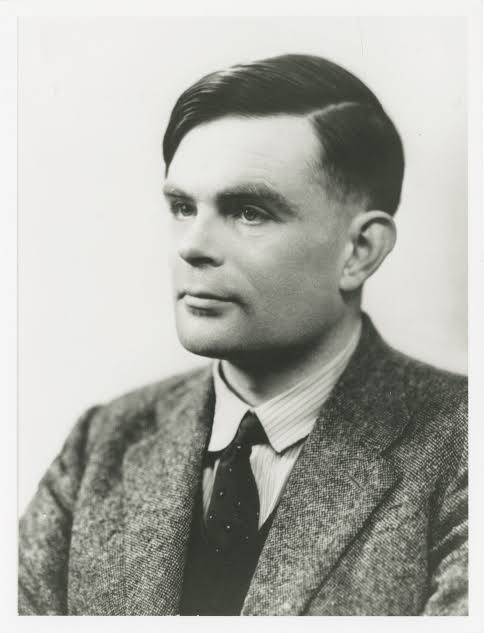
Every time you use a computer, a smartphone, or ask artificial intelligence a question — you are touching the mind of Alan Turing. He imagined the computer before it existed. He helped win World War II by cracking a code the Nazis believed was unbreakable. He asked the question that created artificial intelligence: _"Can machines think?"_
And how did Britain repay the man who saved millions of lives? They arrested him, chemically castrated him, and left him to die alone at 41.
This is one of history's greatest stories — and its greatest injustices.
The Strange Boy Who Read About Machines
Alan Mathison Turing was born on June 23, 1912, in London. His father worked in the Indian Civil Service, so young Alan was raised mostly by a retired couple while his parents were abroad. He was a quiet, odd, friendless boy — obsessed with numbers, puzzles, and asking strange questions.
His teachers were frustrated by him. One headmaster wrote: _"If he is to stay at public school, he must aim at becoming educated. If he is to be solely a Scientific Specialist, he is wasting his time at a public school."_ They saw a boy who ignored Latin and literature. They didn't see a mind operating on another level entirely.
At 13, at Sherborne School, he fell deeply in love — intellectually and emotionally — with a boy named Christopher Morcom, the only person who shared his love for science and mathematics. Then tragedy struck: in 1930, Christopher suddenly died of tuberculosis.
Alan was shattered. But in his grief, something formed — a lifelong question: can a mind exist beyond the body? What happens to Christopher's thoughts, his intelligence? Could a mind ever be built — or preserved — in a machine?
That question would eventually give the world computers and artificial intelligence.
His only "friend" in grief was mathematics. He wrote to Christopher's mother:
> _"I feel that I shall meet Morcom again somewhere, and that there will be some work for us to do together."_
Cambridge and the Machine That Invented the Computer
Turing earned a place at King's College, Cambridge, and by 22 was elected a Fellow — a rare honor. His mind was now fully unleashed.
In 1936, at just 24 years old, he published a paper with one of the most boring titles in history — _"On Computable Numbers"_ — inside which hid one of the greatest ideas ever conceived.
Turing described an imaginary machine — a simple device that could read symbols on a tape and follow logical instructions. This imaginary device, later called the "Turing Machine," proved something astonishing: one universal machine could, in theory, compute anything that is computable.
In other words: before any computer existed on Earth, Alan Turing invented the idea of the computer in his mind. Every laptop, every smartphone, every supercomputer today is a version of the "universal Turing machine." He didn't improve computing — he invented the concept itself.
He took his genius to Princeton University, earned a PhD in mathematics, and worked alongside the great logician Alonzo Church. Then in 1938, he returned to England — just as the world began to catch fire.
Bletchley Park: The Secret War
In September 1939, Britain declared war on Nazi Germany. On the very first day of the war, Turing reported to a place that officially did not exist: Bletchley Park — the secret codebreaking headquarters of Britain.
The enemy was the Enigma machine — Germany's encryption device used by its military. Enigma had 159 quintillion possible settings (that's a 159 followed by 18 zeros). Every night at midnight, the settings changed. The Germans were certain it was absolutely unbreakable. If they were right, their U-boat wolf packs would strangle Britain into starvation, and their air force would own the skies.
The Polish had made early breakthroughs before the war and passed their knowledge to Britain. But the Germans kept upgrading Enigma. Britain needed a miracle.
The miracle was a 27-year-old mathematician named Alan Turing.
The Bombe: Breaking the Unbreakable
Turing designed "the Bombe" — an electromechanical machine that could rapidly test Enigma settings and eliminate wrong ones automatically. It wasn't a computer in the modern sense, but it was thinking machinery — the ancestor of everything that came after.
Then Turing made a genius-level leap. He realized the German messages weren't random — they followed patterns. Every message, for example, contained predictable words like "WETTER" (weather) at fixed positions. These predictable fragments — called "cribs" — gave his machine a mathematical wedge to crack into the code.
By 1940-41, Bletchley Park — with Turing at its heart — was reading German U-boat messages daily. Convoys could dodge the wolf packs. Ships that would have been sunk sailed safely around danger.
The scale of what he did is almost impossible to comprehend:
- Historians estimate Turing's work shortened World War II by 2 to 4 years. - His work is credited with saving 14 to 21 million human lives. - Bletchley Park's total intelligence operation was code-named "Ultra" — so secret that even most British generals didn't know it existed.
Turing was famously eccentric — his colleagues called him "Prof." He cycled to work wearing a gas mask during hay fever season, chained his coffee mug to the radiator so no one would steal it, and buried silver bars during the war (then forgot where). The chiefs he worked with didn't fully understand him. It didn't matter. He was winning the war with mathematics.
He was awarded the OBE — one of Britain's highest honors — for his war work. The public would never know. The secret was kept for decades.
1945-1950: Inventing the Future
When the war ended, Turing carried his secret mind into the open world — and immediately built the future:
- At the National Physical Laboratory, he designed the ACE — one of the first complete designs for a stored-program electronic computer. - At Manchester University, he worked on the Manchester Baby — the world's first computer to run a stored program (June 1948).
Then, in 1950, he published his most famous paper: _"Computing Machinery and Intelligence."_ In it, he asked the question that created an entire field of science — artificial intelligence:
> _"Can machines think?"_
His answer was the Turing Test — a simple, brilliant game. If a human talks with a hidden machine and a hidden human, and cannot reliably tell which is which — then the machine, for all practical purposes, is _thinking_. Every AI chatbot, every voice assistant, every language model you use today is still measured, in some way, against the test Alan Turing proposed in 1950.
He also predicted a world where machines would learn from experience, where people would converse with computers, and where "machines will be able to compete with men in all purely intellectual fields." People laughed. Today, his predictions read like yesterday's news.
He was elected a Fellow of the Royal Society at 37 — one of the youngest ever.
The Arrest: How Britain Destroyed Its Savior
In January 1952, Turing's house in Manchester was burgled. He reported it to the police. During the investigation, Turing casually mentioned to a detective that he knew the burglar — through a man he was in a relationship with: Arnold Murray.
Turing didn't hide it. He spoke openly, honestly — as if truth should be obvious. Homosexual acts were a criminal offense in Britain at the time. Instead of investigating the burglary, the police investigated _Turing_.
He was charged with "gross indecency" — the same Victorian-era law used against the playwright Oscar Wilde.
His friends begged him to lie, to deny it. Turing refused:
> _"I see no reason why I should be evasive about the matter. I have no hesitation in defending my behavior."_
On March 31, 1952, he was convicted. The court offered him a choice: prison, or probation with "organo-therapy" — chemical castration. To avoid prison — to keep working, to keep thinking — Turing accepted the injections.
For a year, he was forced to take synthetic estrogen — a female hormone — designed to destroy his libido. His body changed. He developed breasts. His security clearance was revoked — the man who broke the Nazi code was now officially a "security risk." He was banned from entering the United States. His colleagues watched the government slowly erase him.
His friend and mentor Robin Gandy described how the injections made him unbearably ill. The great mind that had saved the free world was being chemically reshaped by that same world.
The Apple: June 7, 1954
On the morning of June 8, 1954, Alan Turing's housekeeper found him dead at his home in Wilmslow, Cheshire. He was 41 years old.
Beside his bed lay a half-eaten apple.
The autopsy found the cause: cyanide poisoning. The apple was never tested for cyanide — for reasons never explained. The inquest ruled it suicide. His mother refused to believe it, insisting it was an accident — he had been experimenting with cyanide for chemistry work in his home laboratory.
But the image entered history and never left: the man who spent his life breaking codes, killed — perhaps — by the one code no one could crack. Many noticed the dark poetry: a poisoned apple, like the fairy tale of Snow White. Biographers noted that Turing had loved the Snow White story as a child, reciting the witch's lines: _"Dip the apple in the brew, let the sleeping death seep through."_
One of the greatest minds humanity ever produced died alone, disgraced by the nation he saved, with a bitten apple as his final image.
Fittingly, decades later, a small tech company would build an empire on a bitten apple as its logo — the most famous bitten apple in the world. Whether Steve Jobs intended it as a tribute to Turing has never been confirmed. When asked, Jobs said: _"God, we wish we had thought of it. It's just a coincidence."_ The world didn't quite believe him.
The Apology That Came 55 Years Too Late
For decades, Britain did nothing. Then the world began to remember:
- 2009: Following a massive public petition, British Prime Minister Gordon Brown issued a formal public apology: _"On behalf of the British government... we're sorry. You deserved so much better."_ - 2013: Queen Elizabeth II granted Turing a royal pardon — 60 years after his death. - 2017: The "Alan Turing Law" was passed, posthumously pardoning thousands of men convicted under the same anti-homosexuality laws. - 2021: Turing's face was placed on the £50 note — the highest-value British banknote. The man erased by the state now sits in every wallet in the country. - The film _The Imitation Game_ (2014), starring Benedict Cumberbatch, brought his story to hundreds of millions worldwide and earned 8 Oscar nominations.
In Manchester, a statue of Turing sits on a bench, holding an apple. In Bletchley Park, his office is preserved as it was. In the world of computer science, the highest honor in the field is called the Turing Award — the "Nobel Prize of Computing."
Lessons from Alan Turing's Life
1. Think beyond your time — He invented the computer in theory 10 years before hardware could catch up, and AI 70 years before the world was ready. 2. One mind can save millions — A single mathematician, working in secret, shortened a world war and saved 14 million lives. 3. Truth is expensive — He refused to lie in court, knowing the cost. His honesty destroyed him; it also made him immortal. 4. Society's sins outlive their victims — The greatest tragedy of Turing's story isn't his death, but how long it took the world to say "sorry." 5. Genius has no rules — The eccentric "Prof" with the gas mask and chained mug out-thought the entire Nazi war machine. 6. The mind is the message — His body was broken, but his ideas now run the entire modern world.
Conclusion
Alan Turing asked whether machines could think. The better question history should ask is: could humans think — when they destroyed the man who saved them?
He won the war for Britain. Britain arrested him. He gave the world computers. The world gave him chemical castration. He asked if machines could feel. No one asked how a human was made to feel.
Yet look around you. Every computer scientist is his heir. Every AI is his child. Every keyboard is a tribute. The Nazis couldn't break him, the law couldn't silence his ideas, and death couldn't stop them — because ideas, once unleashed, never die.
He once wrote, in a letter about death and minds:
The body provides something for the spirit to look after and use.
His spirit looked after humanity. Now humanity looks after his memory.
_Did you know Alan Turing's story before reading this? What shocks you most — his genius or the injustice? Share your thoughts in the comments below